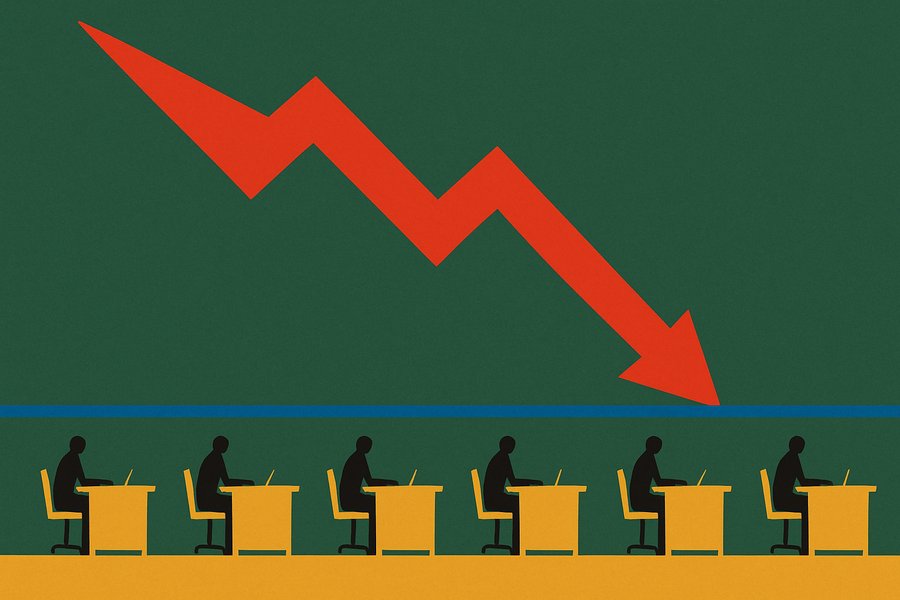
This week California switched on the first government tool in the country built to catch artificial intelligence destroying jobs in real time. The striking part was not the dashboard. It was the finding printed alongside it: so far, there is no evidence of large-scale AI-related layoffs in the state's labor market.
The California AI-Unemployment Tracker, built with the California Policy Lab and updated monthly, is meant to be an early-warning system, the third piece of Governor Newsom's executive-order push on AI and work. Its first read is cautious rather than calm. Researchers found no statewide surge in unemployment claims from AI-exposed occupations, but they did see patterns worth watching: claims from college-educated workers in high-exposure jobs rose after ChatGPT's 2022 release, and the Bay Area's tech-heavy workforce showed a sustained uptick. "Right now, we are not seeing evidence of large-scale AI-related layoffs," co-author Ben Hyman said, before adding the careful qualifier that the patterns in certain regions and sectors are real.
A separate study landed the same week and pointed the same way. Software engineering is, in theory, the white-collar job most exposed to automation, yet venture firm SignalFire found it was the most resilient function of 2025. Tracking hiring across millions of workers, the firm reported that while overall hiring at big tech companies fell 25 percent against 2019 levels, engineering roles slipped just 11 percent, and engineers still made up 55 percent of new hires at the twelve firms it calls the Tech Majors. That sits awkwardly next to outplacement firm Challenger, Gray & Christmas, which logged the highest monthly tech-layoff total in years in May, with AI the most-cited reason. As SignalFire's head of research put it, the stated rationale and the hiring data are "a little inconsistent."
None of this has slowed the machinery of worry. The same week, former Commerce Secretary Gina Raimondo and former Indiana Governor Eric Holcomb launched RAISE US, a bipartisan nonprofit starting with more than $500 million for retraining, backed by Amazon, Microsoft, Anthropic, the OpenAI Foundation and Bank of America. Raimondo's pitch is blunt: unemployment from AI "could destabilize our country and our democracy." Her evidence is the forecasts, a Boston Consulting Group estimate of up to 25 million jobs eliminated in five years, a Goldman Sachs projection that a quarter of work hours could be automated. President Trump, asked whether truckers should worry, simply waved it off: "Right now, they're not."
The gap between those two registers is the actual story. The forecasts describe a future; the trackers describe a present, and the present is quieter than the headlines promised. The honest reading is not that AI is harmless to work, but that the damage so far is narrow and uneven, concentrated among the most exposed rather than spread across the economy. That leaves an uncomfortable question hanging over every dashboard and retraining fund being stood up this month: are these tools fast enough to get ahead of the disruption, or are they built only to confirm it after it has already arrived?