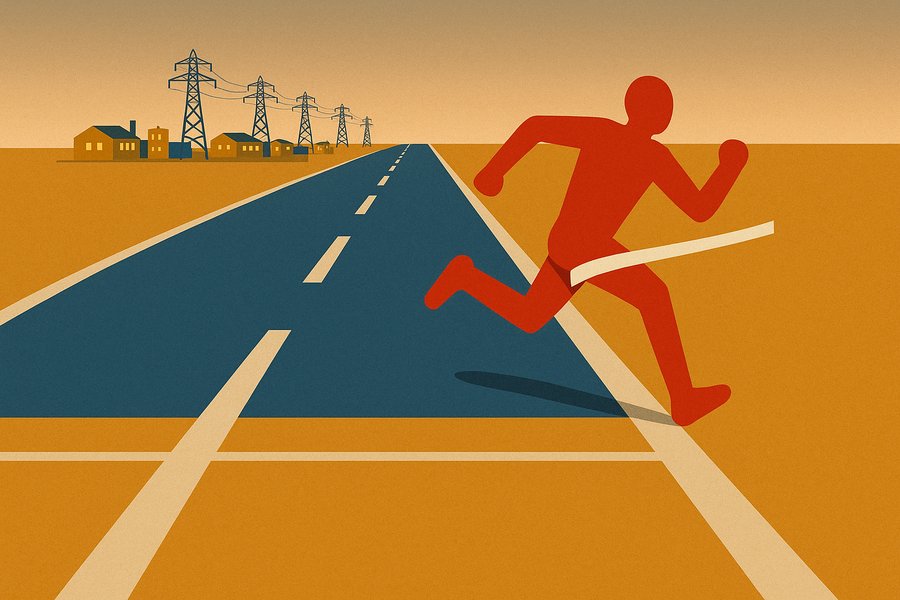
In the same week that JP Morgan told clients the United States still holds "a commanding lead" in artificial intelligence, a Chinese chief executive was on X telling Elon Musk the gap was smaller than he thought, and three analysts on a Brookings podcast were quietly arguing that the word everyone reaches for, "race," is the wrong one. Three takes, one stubborn question: how far ahead is America, really, and ahead at what?
Start with the numbers that fuel the anxiety. JP Morgan's report, cheerfully titled "Semiquincentennial: the US grip on global markets at 250," gives the US the lead it expects: frontier labs, semiconductors, hyperscale clouds, and the best productivity figures in the G10. But it flags a soft spot. The "efficient frontier" of price against performance is now "dominated by China," naming DeepSeek, MiniMax, Xiaomi and Alibaba. By April 2026, the bank says, leading Chinese open-weight models scored within a few dozen Elo points of closed frontier systems while costing 10 to 50 times less per token. OpenRouter shows a surge in API calls to those models, and some enterprises have already begun shifting workloads to the cheaper options.
What experts dispute is the speed of the gap closing, not the direction. Stanford's AI Index now describes the American quality advantage as nearly gone. David Sacks, the former White House AI czar, puts the US lead at six to nine months. Alex Stamos warns that China may be sitting on capable models it has not disclosed, and that "thinking we're the best just because we're Americans is arrogant and foolish." Others, like SecurityPal's Pukar Hamal, counter that China still lacks the cutting-edge chips and data needed for genuine frontier work. Everyone agrees the distance is shrinking; nobody agrees how fast.
The Brookings panel, hosted by Ryan Hass with R. David Edelman and Kyle Chan, argues the racing frame "flattens everything." Their sharper distinction: the US is AGI-pilled, fixated on the frontier prize and pouring a projected trillion dollars into compute, while China is "AI-pilled but not AGI-pilled," wiring the technology into factories, hospitals, drug discovery and government services. "While we are looking for benchmarks," Edelman says, "they are wiring the factory floor." On open versus closed models, his analogy is neat: a closed model is going to a restaurant, an open one is being handed the recipe. Plenty of US companies, he notes, quietly cook with the Chinese recipe because it costs a fraction as much.
So who is ahead depends entirely on what you are measuring. Edelman bets on the US for pure frontier innovation, crediting its ability to attract the world's best researchers. Chan splits the verdict: America leads in the virtual world of frontier models and agents, but China is likely to move faster in physical AI, where its robotics supply chain and factory-floor data give it a flywheel that benchmarks never capture. The tension that refuses to resolve is this. The US is winning a sprint toward a prize that may never announce its arrival, while China builds the road the technology actually travels on. The spending gap is widening and the capability gap is narrowing. Only one of those trends looks sustainable, and the contest is really an argument about which.