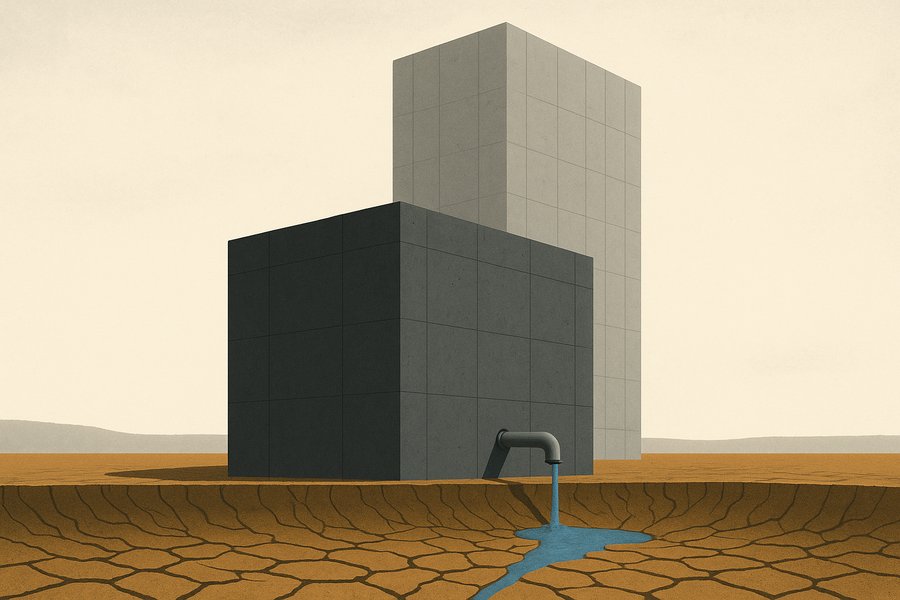
As Europe baked under its second heatwave in as many months, United Nations Secretary-General Antonio Guterres stood up in London on Tuesday and asked the AI industry to do something it has mostly avoided: add up its own bill. Speaking at London Climate Action Week, he launched an AI Environmental Transparency Initiative, calling on every major AI company to measure and publicly disclose the carbon, water and land its data centres consume, and to power those facilities with renewable energy by 2030. "No more hidden costs," he said. "It is time to come clean."
The demand rests on a fresh set of numbers, and they are large. A June report from the UN University Institute for Water, Environment and Health found that data centres burned through 448 terawatt-hours of electricity in 2025, more than the whole of Saudi Arabia, with AI responsible for about a fifth of that. By 2030 the report projects annual consumption will roughly double to 945 terawatt-hours, close to the entire demand of Japan, with AI's share climbing to 40 percent. Water use is on a similar curve, from 4.5 trillion litres last year toward 9.3 trillion by the end of the decade, alongside a land footprint set to more than double.
What the report does most usefully is reframe a debate that has fixated on electricity. "The public debate still often treats AI as software, but AI is also physical infrastructure: data centers, electricity generation, cooling systems, transmission networks, chips, minerals, land and water," said Kaveh Madani, the institute's director and lead author. His warning is geographic as much as global. AI will not simply run out of water or power everywhere at once; the danger is that poorly planned construction collides with local scarcity, and that the burden tends to land where land is cheap and oversight is light.
The honesty Guterres is asking for is genuinely in short supply. Operators rarely publish granular figures for the water a given site draws or the emissions tied to a particular model, which leaves researchers to estimate and the public to guess. The disclosure push is an attempt to convert that field of educated guesses into something regulators can audit. Context explains why the timing is awkward: by the International Energy Agency's count, coal still supplies about 30 percent of data-centre electricity, with renewables at 27 percent, natural gas at 26 percent and nuclear at 15 percent. A coalition of cities, meanwhile, announced a Global Urban Data Centres Pact, with London Mayor Sadiq Khan noting that residents "are right to expect growth to be managed responsibly."
The catch is that none of this is binding. The UN report names no companies and prescribes no hard caps, leaving the harder politics of enforcement to governments, and the disclosure itself remains, as one account put it, in the gift of the companies. The pressure is real but the building is realer: US utilities are bracing for a $1.4 trillion capital surge to feed the data centres planned by 2030, and projects like Meta's gas-powered campus in Louisiana show how readily a grid's shortfalls get filled with fossil fuels rather than the clean power being requested. Guterres framed the moment, borrowing from Dickens, as a tale of two crises sharing one origin in fossil fuels. Whether transparency becomes a standard or stays a suggestion is the question his initiative leaves open, and it is the companies, not the UN, who will answer it.