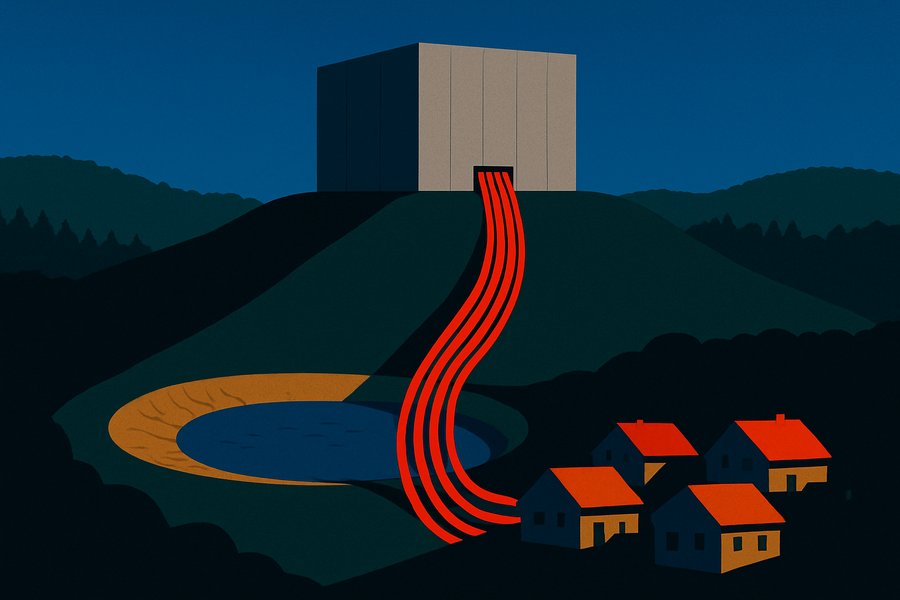
Federal regulators did something on Thursday that would have looked unremarkable a decade ago and reads very differently now. The Federal Energy Regulatory Commission ordered six regional grid operators, which together serve two-thirds of the country, to connect the nation's largest power users to the transmission system faster. The users it has in mind are artificial intelligence data centers, some of which draw more electricity than a small city. Energy Secretary Chris Wright had pushed for the move as a way to keep the United States ahead of China, and the commission's chair, Laura Swett, called the unanimous vote historic.
The timing is the real story. In the same stretch of days, a United Nations report arrived with the opposite mood. It estimated that the energy used to power AI could climb to 3 percent of global electricity demand by 2030, and that the data centers underpinning it could, if treated as a country, rank sixth in the world for energy use. Its most arresting figure was about water: the cooling and power needs behind AI could consume as much as the 1.3 billion people of sub-Saharan Africa use for their domestic needs in a year. One arm of public life is clearing the road for these machines while another is totting up what they cost to run.
Kaveh Madani, who led the UN report, makes a point that cuts through the abstraction. AI feels virtual, he says, but behind every prompt sits a physical supply chain that runs from mined minerals to drained reservoirs to electronic waste. And the costs are not shared evenly. The richest users and countries capture most of the benefit, he argues, while the communities near the mines and the dry valleys chosen for data centers absorb the pollution and the water stress. Some facilities are already being built in places his team calls water bankrupt, where a town may soon have to choose between irrigating crops and cooling servers.
It would be easy to read all this as a straightforward villain story, and just as easy to overcorrect. Newsweek, surveying the panic, lined up nine things that are worse for the climate than data centers, among them beef, cement, aviation and cryptocurrency mining. US data centers used roughly 4.4 percent of national electricity in 2023, real but smaller than the rhetoric suggests. The useful caution there is against false equivalence cutting the other way: that something else is worse has never made a thing harmless, and one analyst quoted in the piece notes that much of AI's promised value is still theoretical while its resource draw is already measurable.
There is even a version where the machine helps. Energy experts told the Financial Times that AI is unusually good at finding waste in complex industrial systems, spotting the inefficiencies hidden across thousands of motors, pumps and valves that no team of humans could track. Paired with digital twins, it has cut unplanned downtime and energy costs at some renewable plants by a quarter or more. The catch, as one specialist put it, is that AI uses so much energy itself that it now has a lot of heavy lifting to do simply to wash its own face.
That is the tension FERC just sharpened. The order makes the data centers pay for their own grid upgrades, but it cannot conjure new power plants, and it does little about the bills and blackout warnings already spreading where construction outpaces supply. Washington has decided the race is worth running flat out. The open question is who is standing downstream when the water runs low.