For two years the chief executives of the biggest AI labs competed to sound the loudest alarm about work. Anthropic's Dario Amodei warned that AI would wipe out more than half of all entry-level white-collar jobs within five years. Sam Altman of OpenAI made his own grim forecasts. Now both have quietly changed their story, and the timing deserves a second look.
Amodei's new line, delivered on stage with JPMorgan's Jamie Dimon last month, is reassuring by comparison: "If you automate 90% of the job, then everyone does the 10% of the job, and the 10% kind of expands to be 100% of what people do." Altman, who once warned of a similar cleaving of the labour market, said in May that he had been "pretty wrong" about AI's economic impact. As the Bloomberg columnist Parmy Olson notes, the change of heart is fortuitously timed. Both companies are reportedly nearing private valuations around a trillion dollars and preparing for public listings. The audience for the AI pitch is no longer just cost-cutting businesses; it is now institutional investors and pension funds wary of regulatory backlash.
There is a decent case that the original alarm was overstated. Despite a record year of tech layoffs, with nearly 120,000 jobs cut, careful analyses keep failing to find economy-wide AI unemployment. Anthropic's own labour research found no systematic rise in joblessness among highly exposed workers. Much of the cutting looks like a correction for pandemic over-hiring, with AI offered as a convenient explanation. The data, in other words, supports the calmer tone better than it ever supported the panic.
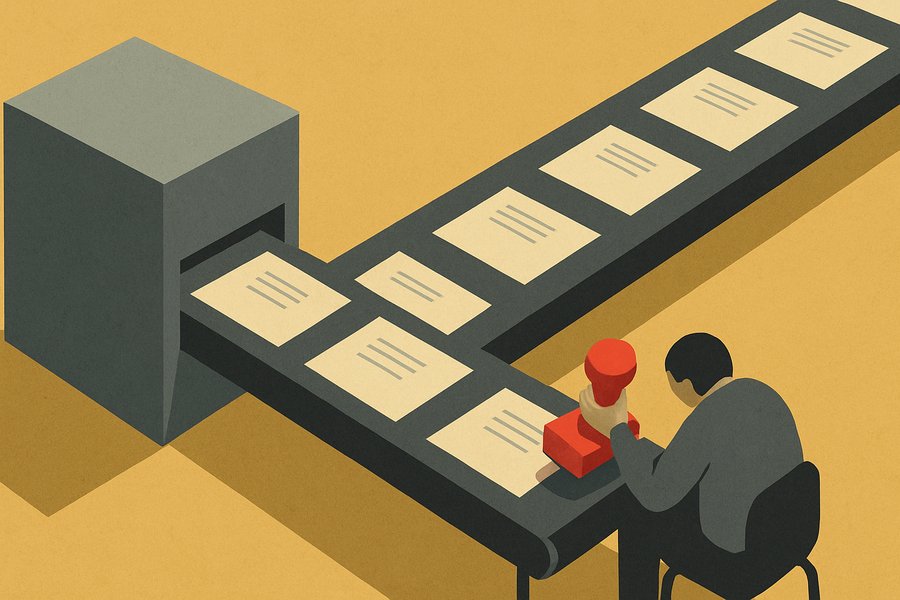
But the relief glosses over the question that neither forecast addressed: not whether the jobs survive, but whether they remain worth doing. AI does not replace whole jobs so much as hollow out their interiors. Olson points to the work of Financial Times journalist Sarah O'Connor, who profiles subtitle translators now editing machine output, truck drivers babysitting self-driving rigs, and warehouse staff guided shelf to shelf by robots. The work that remains is often more intense, lonelier and less creative. The pattern is not new. A century ago, Frederick Winslow Taylor broke factory labour into tiny standardised tasks, lifting output while reducing workers to interchangeable parts, and the resentment helped trigger waves of strikes.
The same fault line runs through the more optimistic accounts. The "human sandwich" model favoured by Every's Dan Shipper, and echoed in Indian policy circles, holds that a person frames the problem, AI executes, and a person reviews and corrects. That keeps humans in the loop, but it quietly assumes the loop is fulfilling. Reviewing the output of a swarm of agents is not obviously better work than producing it yourself, and ClickUp's chief executive has already described restructuring his company so that staff manage thousands of bots rather than do the tasks themselves.
The cost of getting this wrong lands hardest on people with the least cushion. As Fortune reports, the American safety net is badly suited to a slow grind of displacement: nearly three-quarters of unemployed people never even file for benefits, often because they assume they are ineligible, and the system has barely changed since the New Deal. If the disruption is real but diffuse, spread across degraded roles rather than mass firings, it will be exactly the kind that statistics miss and support systems ignore. The bosses have stopped predicting the death of jobs. The more useful question, still unasked, is whether the jobs that survive will be ones anyone wants to keep.