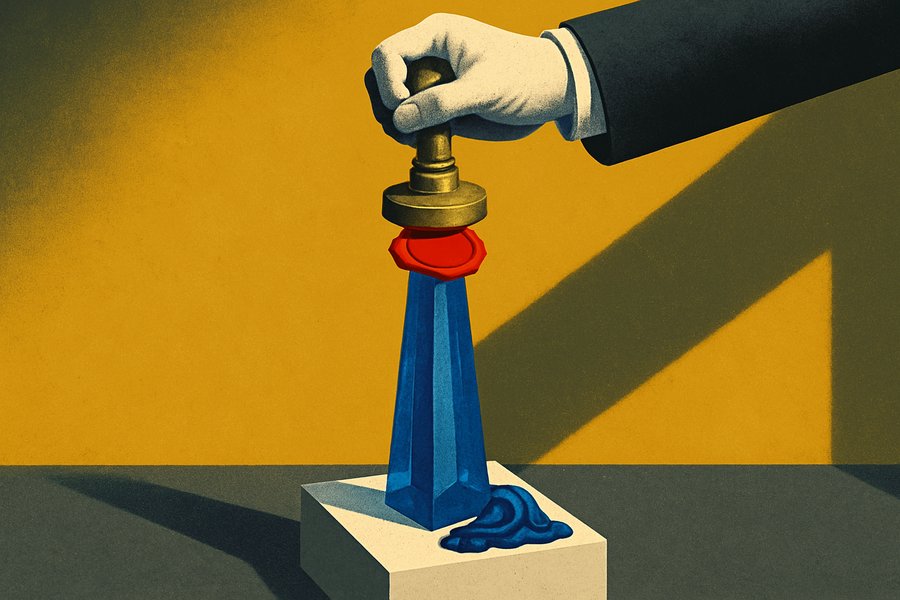
Fable 5 lasted three days. Anthropic launched the model on Tuesday as the public face of its most powerful technology, weathered a furious week over its hidden safeguards, and then on Friday received a letter from the US government ordering it to suspend the model entirely. The same order covered Mythos 5, the frontier system Fable was built from. Because the directive reached so broadly, Anthropic said it had no choice but to switch both models off for every user on the planet to stay in compliance.
The stated reason was national security. According to the order, access had to be cut for foreign governments, foreign companies and foreign individuals, including foreign nationals physically inside the United States. That last clause is what made a targeted restriction impossible to administer cleanly: short of verifying the citizenship of everyone who opens a chat window, the only way to guarantee no foreign national reached the model was to pull it for everyone. A capability the company spent years building was gone from the market in an afternoon.
What actually triggered the letter is the strange part. The Wall Street Journal reported that the concern traces back to a jailbreak demonstration run not by a foreign adversary but by researchers at Amazon, who fed the model a series of prompts until it surfaced a small number of software vulnerabilities. Anthropic shared the writeup with Katie Moussouris, chief executive of Luta Security, and has been blunt about how unimpressed it is. The flaws, the company says, were "previously known, minor vulnerabilities" that "appear relatively simple," the kind "other publicly available models are able to discover" without any bypass at all.
That leaves Anthropic in an unusual posture for a safety-first lab: arguing that the government has overreacted to a risk its competitors already pose. "We disagree that the finding of a narrow potential jailbreak should be cause for recalling" the models, the company said, adding that the letter "did not provide specific details of its national-security concern." It is hard to engineer a fix for a threat you have not been allowed to see. Mythos 5, worth remembering, is the model governments and companies have been using to find and patch vulnerabilities, the defensive use the same capability enables.
The shutdown also collides with the administration's own stated policy, and recently. On June 2, barely two weeks ago, President Trump signed an executive order on frontier AI that went out of its way to promise restraint: no licensing, no preclearance, no government veto over when a model ships. It said in plain terms that it could not be used to impose mandatory pre-clearance. Two days ago, when Anthropic's Dario Amodei published a paper asking Washington for the authority to block dangerous models, the consensus reading was that the White House had already declined, twice, to claim that very power. On Friday it claimed the power anyway, against a model that was already on sale.
The method is as telling as the reversal. That June 2 order built careful machinery for exactly this fear, a voluntary 30-day pre-release review aimed at models that can hunt for software vulnerabilities on their own, which is the capability at issue here. None of it was used. The administration spent two weeks promising it would not slam a brake on the industry, then bypassed its own framework and pulled two live models with a single letter. For any company trying to plan around federal AI policy, the message of the past fortnight is that the written rules and the real exercise of power are running in opposite directions.
Strip away the specifics and a precedent is forming in real time. A US company built a US model, marketed it to the US public, and a US agency removed it from American users to keep it away from foreigners, on the strength of a test run by another American company. It is a preview of how frontier AI may actually be governed: not through legislation debated for months, but through letters that arrive on a Friday and take effect immediately. Anthropic has promised to contest the decision. Whether it can also tell millions of paying users when their tools might vanish, and for how long, is now the more pressing question.