On Monday, Sam Altman and OpenAI chief scientist Jakub Pachocki published a blog post declaring that OpenAI is entering its "third phase," a stretch in which advanced AI must become "abundant, affordable, safe, useful, and easy enough for every person and organization to benefit from it." They also called, again, for an international body that could "slow down the development of frontier models if needed." Hours later, the same company confirmed it had confidentially filed for an initial public offering.
Anthropic confidentially filed for its own IPO last week. Researchers at the Claude maker had just published a piece arguing that AI is advancing fast enough that leading labs "may need to slow down" so societal structures and alignment work can catch up. Aravind Srinivas, the chief executive of Perplexity, told CNBC his company is still planning a 2028 listing regardless of how either rival's offering lands.
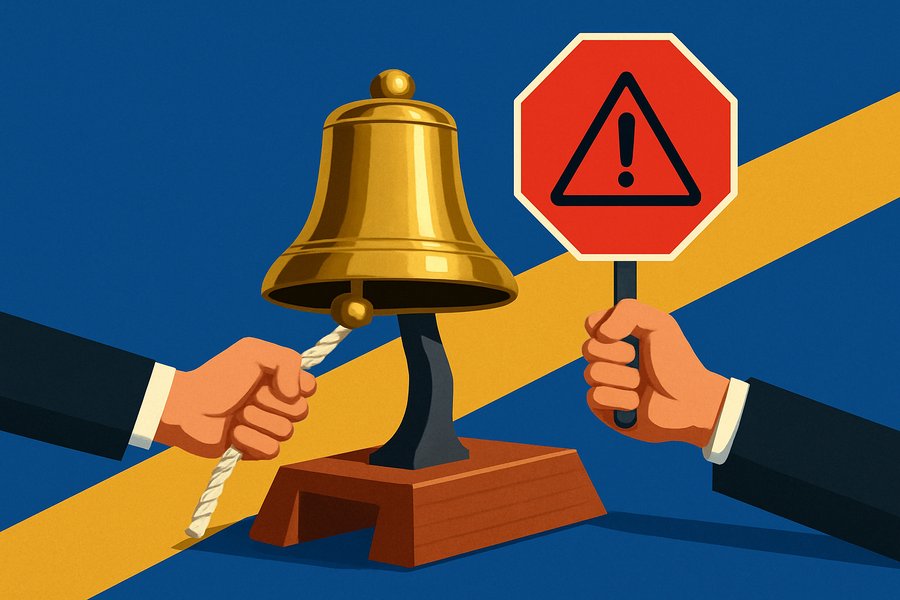
Read the documents on their own and each one makes sense. Read them together and a strange split emerges: the firms most loudly warning that frontier AI may be moving too quickly for society to absorb are also the firms most loudly asking public markets to fund the next leg of the race.
The contradiction has been building for a while. Altman and Pachocki frame the third phase around three goals: an automated AI researcher, a faster economy, and "a personal AGI" for every human. They also write that "a good AI future cannot be one where a small number of institutions control most of the capability and most of the upside," and that "entirely automating everything is not the future we want." A public OpenAI would, by definition, have shareholders who do want as much capability and upside concentrated in one institution as possible. The investor pitch and the safety pitch are now being printed on the same letterhead.
Srinivas, sitting outside the IPO bubble, offered the most practical read of the moment. Asked what happens if either offering disappoints, he was blunt: "I certainly think there will be ripple effects if they don't go well, like there is no sugar coating on that." He defended the steep valuations attached to OpenAI and Anthropic but added a condition that should worry both. "If for six months you don't see a model capability advance from one of these two companies, then it's a problem for them." A frontier lab can preach restraint, but a public frontier lab will be punished for it by the same quarter.
There is also a quieter signal in Srinivas's own purchasing decisions. He told CNBC that customers, his included, are getting more selective. "If there is an open source model that gets the job done 90 percent of the time, I'd probably use that if it's 10 to 20 times cheaper than the frontier model." That sentence is the bear case for both upcoming IPOs in a single line. If buyers are increasingly happy with cheaper alternatives, the premium attached to the frontier shrinks, and a slowdown becomes harder to sell as anything other than ceding ground.
None of this means OpenAI or Anthropic are insincere about safety. It means their incentives are about to change in a way that will be very hard to reverse. A private lab can pause; a public one will have to explain a pause in a 10-K filing. Investors will read the "third phase" essay and the "we may need to slow down" memo as marketing for governance credibility, not as forward guidance. The market will price the race, not the caution.
The interesting question, then, is what happens when those two messages have to share a quarterly earnings call. The labs are betting they can hold the contradiction together for long enough to ring the bell. After that, the contradiction belongs to their shareholders.