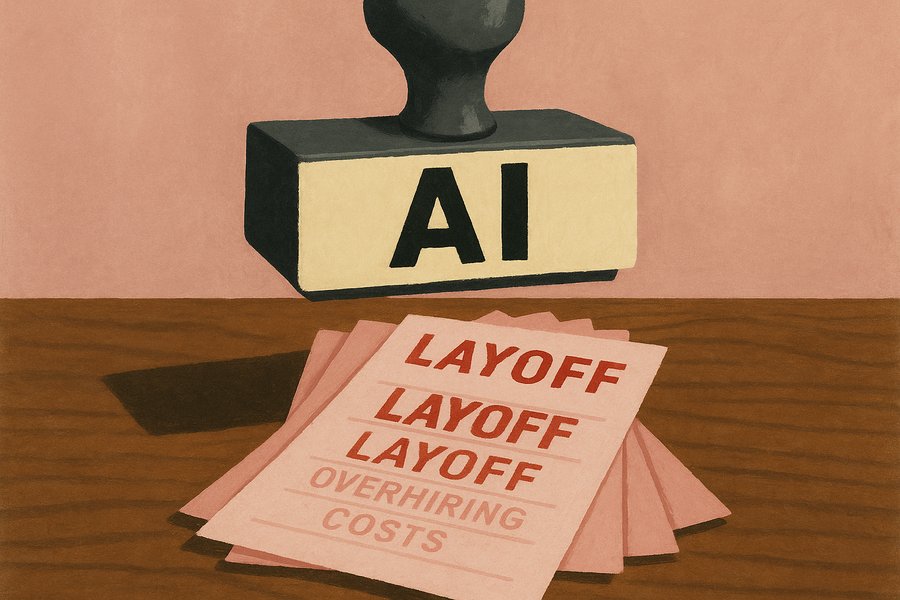
When Challenger, Gray & Christmas released its May layoff report this week, the headline number was unambiguous. Nearly 40 percent of all US job cuts announced in May were attributed by employers to artificial intelligence, up from 7 percent in January. Through five months of 2026, AI-cited layoffs reached 87,714, more than the firm tracked across all of 2024 and 2025 combined. The technology sector alone shed 38,242 roles in May, its worst month since August 2024.
Read straight, the story is simple: a long-promised wave of AI displacement has finally arrived. But a growing number of economists and labour-market researchers say the picture is messier, and that something the industry now calls "AI washing" is doing a lot of the heavy lifting in those numbers.
Gartner's analysis is the bluntest. The firm calculates that only 1 percent of publicly announced 2025 layoffs were actually attributable to AI productivity gains, while more than 80 percent had nothing to do with the technology at all. "It is a classic exercise of freeing up resources to invest more heavily elsewhere," Gartner VP analyst Helen Poitevin told the Globe and Mail. A European Central Bank study found no significant difference in hiring or firing between firms that use AI intensively and those that do not, and in some cases AI-heavy firms were slightly more likely to be hiring.
Roger Lee, who tracks tech layoffs at Layoffs.FYI, says there is "very little evidence" the cited AI tools can actually do the work of the laid-off employees. Sam Altman has gone further, publicly warning that some firms are using AI as cover for cost decisions they would have made anyway. Deutsche Bank analysts have given the practice a clinical name: AI redundancy washing.
Uber became this week's test case. The company cut 23 percent of its People and Places division, the team that runs HR, recruiting and culture, then insisted AI had nothing to do with it. The timing strained credulity. Uber disclosed earlier this year that close to 70 percent of the code it ships is now AI-generated, and the company burned through its 2026 AI coding budget in just four months. Whether AI did the trimming or merely paid for it, the optics are the same.
The entry-level story is the part of the narrative that survives the scrutiny. Across surveys from Mercer, Oliver Wyman and McKinsey, the share of companies planning to cut junior roles has climbed from 17 percent to 43 percent in a year. Banks are slashing analyst classes by up to two-thirds while sourcing the majority of their AI talent from those same intakes, a contradiction with a built-in time bomb. As McKinsey's Debasish Patnaik put it, "senior judgment cannot be manufactured laterally."
Yet even here, a counter-current is visible. Bloomberg columnist Conor Sen notes that 20-to-24-year-old unemployment has fallen year on year every month of 2026, and software-development job postings have been climbing since February. Bank of New York Mellon has tripled the size of its analyst and intern classes to bring in what its CEO calls "a cohort that's naturally AI inclined." The Strada Education Foundation surveyed 1,500 employers and found three times as many expect AI to increase entry-level hiring this year as expect it to decrease.
The most defensible reading is also the least dramatic. AI is genuinely changing what entry-level work looks like, and some real displacement is happening at the bottom of the ladder. But the 40 percent figure is doing two jobs at once: counting cases where automation actually replaced workers, and providing a respectable label for cost-cutting that would have happened in any case. Both readings can be true. They can also be told apart, if anyone in management is willing to do the harder accounting.