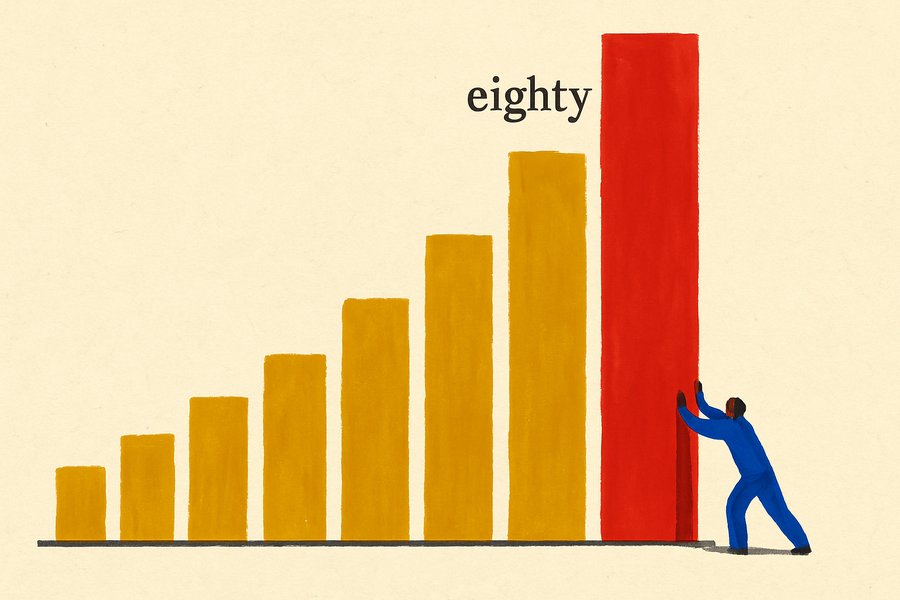
Anthropic published a blog post on Thursday asking governments and rival AI labs to figure out, together, how to slow down or pause development of the most powerful systems. The reason the company gave was unusually concrete. More than 80 percent of the code merged into Anthropic's own codebase is now written by its model, Claude, up from less than 10 percent in February last year. A typical engineer there now merges eight times as much code per day as in 2024. One employee quoted in the post said it had been about five months since they last wrote code themselves.
The reason that number matters is what it implies about the next number. If a frontier lab can use its own model to do most of the work of building the next model, the path to what researchers call recursive self-improvement, an AI system capable of designing and developing its successor without much human help, starts to look less like a thought experiment and more like an extrapolation. Marina Favaro and co-founder Jack Clark, writing for the company, said the trend "points to an AI system capable of fully autonomously designing and developing its own successor" and warned this would "increase the risks of humans losing control over AI systems."
The company stopped short of calling for an immediate halt. Instead it argued that any meaningful slowdown would need multiple well-resourced labs in multiple countries to agree to stop under conditions everyone could verify, and that a unilateral pause by one company would change nothing. The analogy Anthropic reached for was nuclear arms control, while admitting the comparison flatters the problem: missile silos are harder to hide than a training run.
The timing is what makes the post interesting to read. The same week Anthropic published it, the company confidentially filed its S1 draft for an IPO that could value it at around a trillion dollars. OpenAI is racing for the same window. The post sits next to a series of executive statements about how fast AI is now substituting for human labour. Google has said its models generate 75 percent of its code. Mercor's CEO recently said the startup spends more on AI tokens than on salaries. A growing list of companies has attributed layoffs to the same trend.
Pushback came quickly. The investor David Sacks wrote on X: "In other words, you want the government to save us from ... you." White House officials and others in the industry have long argued that Anthropic's focus on worst-case scenarios overstates the risks, and looks suspiciously like a competitive strategy dressed up as principle. OpenAI's own report published Wednesday took a different tack, arguing that "democratic governments, not private companies acting alone, must ultimately determine the rules, safeguards and accountability mechanisms." It is a position that lets a lab keep racing while putting the brake firmly in someone else's hands.
President Trump signed an executive order this week giving the federal government 30 days to conduct a preliminary review of the most powerful US AI models before release, and said during his recent Beijing visit that he discussed AI safety cooperation with China. Whether either thread leads anywhere is the open question. Anthropic says it plans to convene officials, scientists, advocacy groups and competing firms in coming months to design the verification machinery a global pause would need. It is also, in the meantime, training the next Claude. Both things are true, and the company is asking the world to hold those two facts at once.