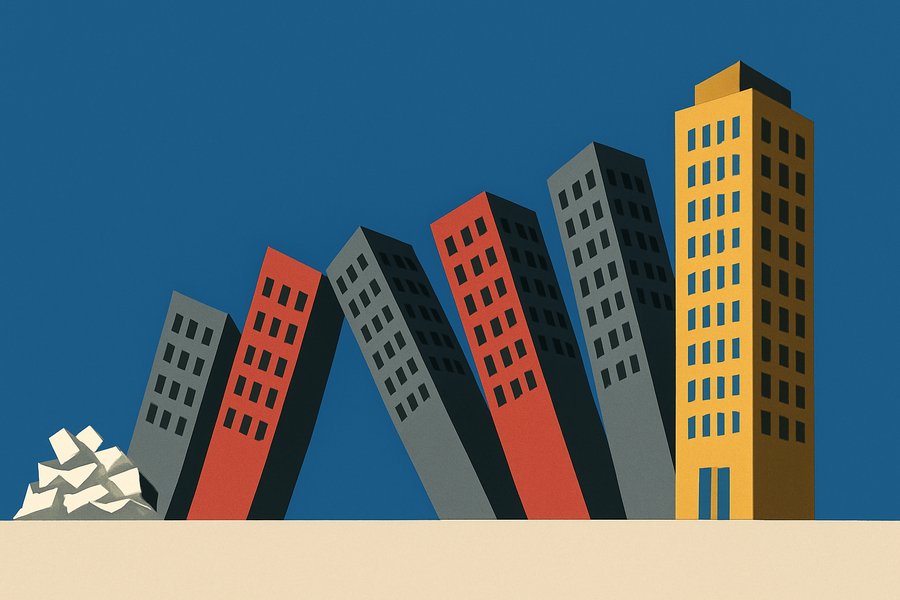
Five years ago, a software startup with a billion-dollar valuation and a hundred engineers could comfortably assume that, at the very worst, a tech giant would buy it for the team. That floor is gone. PitchBook data shared with CNBC this week shows more than 220 American unicorns have effectively become stranded: each reached a billion-dollar valuation by 2021 or 2022, and almost none have raised since. Together they account for nearly half of all U.S. unicorns, a quieter mirror of the public-market hammering that companies like Salesforce and ServiceNow have taken this year.
The pattern looks generational. Startups that last raised in 2021 are now estimated to be worth 68 percent less. The 2022 vintage is down 52 percent. The single biggest cluster on PitchBook's list is software-as-a-service: 75 SaaS firms, double the number of fintechs in second place. Calendly sits there. So do Glossier, Brooklinen, The Farmer's Dog, AG1, Betterment and SeatGeek. Some are still growing. None can plausibly justify their old valuation.
Investors are giving the same explanation in different words. "All workflow-driven enterprise SaaS companies will be either disrupted or dead in the next decade," David Zhu, an ex-DoorDash engineering head, told CNBC. McKinsey's Noshir Kaka, speaking on a Newsweek webinar this week, was blunter: "If you're standing still, you're pretty much dead." McKinsey's survey work suggests roughly seven in ten enterprises are raising their technology budgets even as classic services spending falls. The money is just moving toward a different stack.
What is more interesting is the second-order shift happening inside corporate buyers, which one industry sales chief calls the "Cover Your Assets" economy. Writing in Forbes, Templafy's Jean-Marc Chanoine describes a sales floor where the CFO has replaced the CTO as gatekeeper, where Uber is reported to have burned through its entire annual AI budget in four months on Claude Code tokens, and where Fortune 500 buyers will openly admit a smaller vendor's product is better and still refuse to sign. The fear is no longer that AI does not work. It is that the previous AI bet, the one already booked as transformation, will look foolish if a different vendor wins.
That dynamic compounds the fallen-unicorn problem. The traditional bailout for a pre-AI software company was an acqui-hire at roughly two million dollars per engineer, an estimate Khosla Ventures' Samir Kaul confirmed to CNBC. The math relied on engineers being scarce, which Codex and Claude have quietly broken. A separate Atlassian study out this week found that 84 percent of UK knowledge workers now use AI daily and 71 percent feel faster, yet 70 percent rate their own firm's processes as "okay" or "poor." Individual speed is up. Business-wide productivity is flat. The firms most exposed are the ones whose value proposition was a workflow tool sold per seat.
There is no obvious soft landing. PitchBook analyst Andrew Akers told CNBC that companies which have not raised since 2021 or 2022 are unlikely ever to do so again, and that the most plausible exit is acquisition at a fraction of past value. Stash already sold to Grab for less money than it had raised. Step sold to MrBeast for an undisclosed but, by everyone's account, small amount. The first dominoes have already fallen, and quietly. The more interesting question is no longer whether the rest of the pre-ChatGPT cohort gets re-rated. It is who is still standing in 2027 to write the cheques.