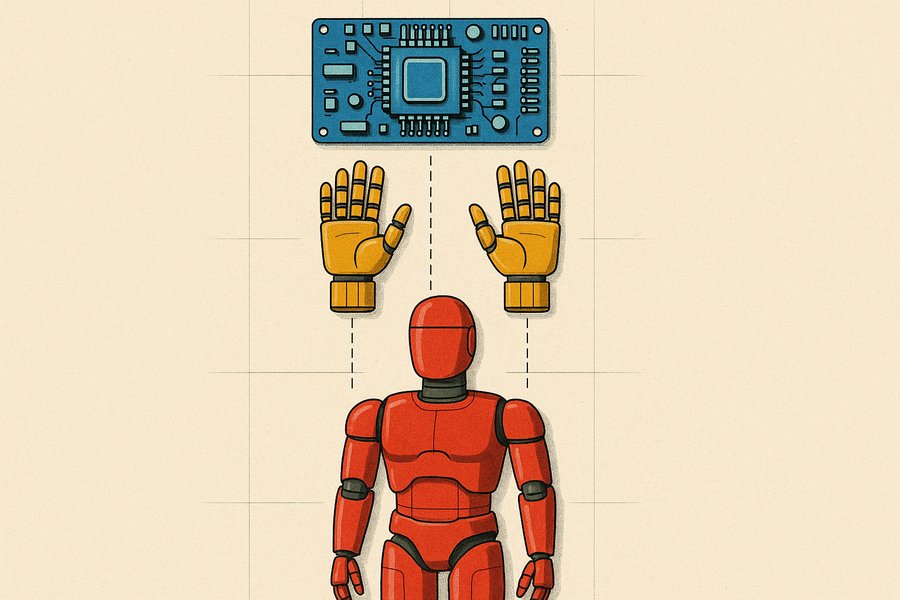
A nearly six-foot Unitree humanoid, a pair of tactile five-finger hands made in Singapore, and an Nvidia compute brain. That is the package Jensen Huang unveiled in Taipei on Monday, calling it the Nvidia Isaac GR00T Reference Humanoid Robot. It is also a quiet pivot in how the humanoid industry gets built, because for the first time the company most likely to define the platform layer is putting its chips inside someone else's body and giving the whole thing away as a blueprint.
Nvidia's pitch is that humanoid development is fragmented and slow. Researchers spend months wiring up cameras, picking actuators, writing simulation code, and hand-holding a robot through demonstrations before they can train any policy. The new design collapses that into one box: a Unitree H2 Plus chassis with 31 degrees of freedom, dual Sharpa Wave hands that add 44 more, a Jetson AGX Thor module running on Nvidia's Blackwell GPU, and the Isaac GR00T software stack underneath. Stanford Robotics Center, ETH Zurich, Seattle's Ai2 and UC San Diego have all signed on as launch customers. The unit will be available from Unitree late this year.
Two things stand out from the launch. The first is who built the body. Unitree is filing to raise roughly 620 million US dollars on Shanghai's STAR board this week, and the company already books more than 40 percent of its revenue outside China. Nvidia picking it over a US partner like Figure or 1X says something about where the best humanoid hardware is actually being made right now, and it places a Chinese-built robot at the centre of frontier research at four American and Swiss universities. No mainland Chinese institution appears on the launch list. The second is the price posture. The H2 currently lists at 29,900 US dollars, an order of magnitude below the proprietary humanoid platforms most academic labs have been priced out of. Steve Cousins of the Stanford Robotics Center put it plainly: "Robotics moves fastest when researchers can build on open platforms."
Around the announcement the rest of the humanoid market kept moving, and the contrast is jarring. Huang told investors in May that the addressable market for humanoid labour is 40 trillion US dollars, a figure Wall Street has begun pricing into ETFs like KraneShares KOID and into Tesla's 208x forward multiple. On the ground, the numbers are smaller and stranger. A San Francisco startup called Gatsby completed what it says is the first US humanoid home cleaning, charging a flat 150 dollars for three hours of work, partly autonomous and partly teleoperated from Mexico. Encord pays robot puppeteers in its Hayward facility up to 1,000 dollars an hour for training data; the operators spend eight-hour shifts pouring the same cup of coffee, then emptying it back into the pot. Foundation Future Industries, a two-year-old San Francisco startup advised by Eric Trump, has shipped two combat humanoids to Ukraine for live testing.
What ties these threads together is that the showroom era of humanoid robotics is ending, but the productive era has not arrived. Real machines are walking into real apartments and real warzones, yet they still need a human in the loop, often on another continent, when anything ambiguous happens. Nvidia's open reference design does not solve that. What it does is make the experimentation phase cheaper and more interoperable, which is exactly what an industry stuck between demos and revenue needs. The bet is that a thousand small labs running shared hardware will produce the breakthroughs that the big proprietary efforts have not.
There is a geopolitical reading too. Nvidia executives told Reuters the company also plans to ship reference designs with humanoid makers in the United States, Europe and South Korea. Translation: the Chinese partnership is the opening configuration, not the only one. The chips, the software stack, and the data-handling model stay Nvidia's. The bodies are interchangeable. That is the same playbook that made CUDA the default in AI training, and it is the one to watch as Washington and Beijing keep arguing over who owns the picks and shovels of the next industrial wave.
Whether any of this produces a 40 trillion dollar market or a long, expensive plateau will be decided by who actually figures out how to make these machines pour the coffee without spilling it. For now, the most useful thing Nvidia has done is admit that nobody knows yet, and to lower the cost of finding out.