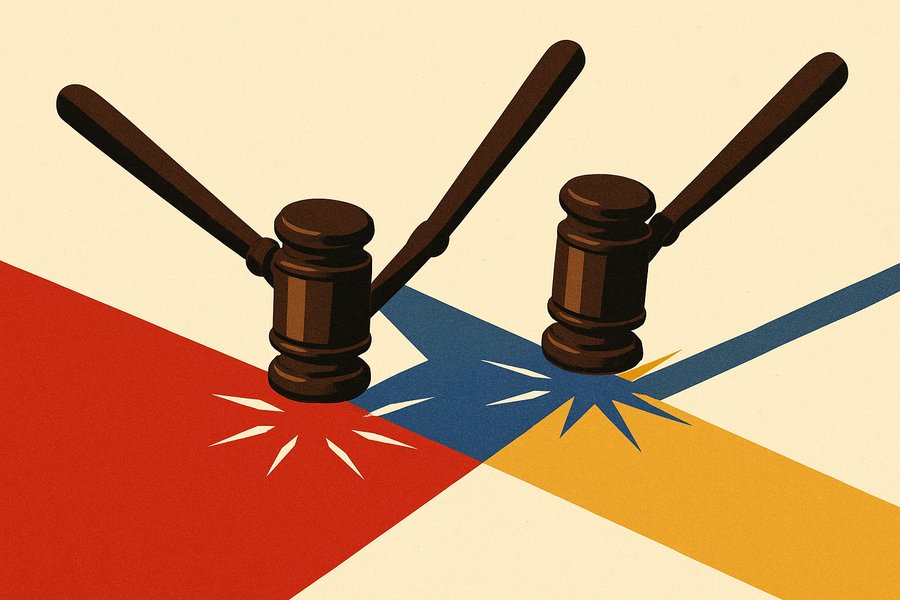
For a decade the lazy shorthand for AI policy was that the rules were coming. Pick the venue you preferred, Brussels, Washington, Sacramento, and wait for it to consolidate. The events of late May 2026 should retire that framing. AI governance is not converging on a single rulebook. It is fracturing into at least three parallel systems, each with its own plaintiffs, its own deadlines, and its own definition of what a well-behaved AI company looks like.
Start with the copyright front, which now reads like an industry roll call. On 28 May, CNN filed suit against Perplexity AI in the Southern District of New York, alleging the company scraped and redistributed more than 17,000 of its news stories, photos and videos. That brings to nine the number of active publisher actions against Perplexity alone, alongside the New York Times, News Corp, the New York Post, the Chicago Tribune, Encyclopedia Britannica, Merriam-Webster, Reddit and Japan's Yomiuri Shimbun. The benchmark in this lane is the Bartz v. Anthropic settlement, a 1.5 billion dollar deal covering roughly 120,000 authors, which had its fairness hearing on 14 May and is awaiting final approval. Other publishers, including Time, Gannett, Le Monde and Der Spiegel, have chosen to license rather than litigate. Either way the trajectory is the same: training and retrieval data, once treated as free, is being repriced in court.
The federalism front is moving in the opposite direction, and is led by the federal government itself. On 9 April, xAI sued to block Colorado's SB24-205, the first comprehensive state AI statute in the country. Fifteen days later the Department of Justice intervened on xAI's side under the Civil Rights Act, the first time Washington has tried to invalidate a state AI law in court. That intervention was the operational debut of Executive Order 14365, signed in December 2025, which created a DOJ AI Litigation Task Force. Colorado has since passed a narrower replacement, SB 26-189, but the litigation stay extends to that too. On 20 March the White House sent Congress a seven-point National Policy Framework for Artificial Intelligence designed to preempt the state patchwork. None of it has become law. Companies are left with both the original state regimes and the federal challenge to them, hanging in mid-air at the same time.
The third front, frontier safety, is the one Washington is not driving. The EU AI Act's transparency rules for general-purpose models become fully enforceable on 2 August, with fines of up to 35 million euros or 7 percent of global turnover for prohibited-system breaches. California's Transparency in Frontier AI Act, signed in September 2025, has been live since the new year. On 28 May OpenAI published its Frontier Governance Framework, mapping its existing internal safety practices onto both regimes at once. The substance was largely already public. The novelty was the explicit alignment, and the implicit dare to Anthropic, Google DeepMind and xAI to publish their own translations before the August deadline.
Layered over all of this are the state-level proposals that do not fit anywhere neatly, including a wave of bills in California and elsewhere aimed at prohibiting AI from "detecting" user emotions or mental states. As Forbes contributor Lance Eliot points out, the language is doomed in its current form, because detection is what large language models do at the level of word statistics. A clean ban would gut the systems. A workable rule would have to regulate use rather than perception: disclosure, consent, restrictions on commercial exploitation. Whether legislators have the appetite to draft at that level of precision is the open question.
For AI companies the practical takeaway is that the three fronts share neither a stakeholder nor a venue, and victories do not transfer. A publisher licensing deal does nothing for EU transparency obligations. A successful constitutional challenge to a Colorado-style law does nothing to lower training-data costs. A polished frontier-safety framework offers no defence in a copyright suit. The compliance posture that handles all three has to be three separate compliance postures stitched together, which is exactly the outcome the White House framework was meant to prevent and exactly what is happening anyway.
The honest read of the last week is that 2026 is not the year AI governance settles. It is the year the industry stops being able to pretend a settlement is on the way.