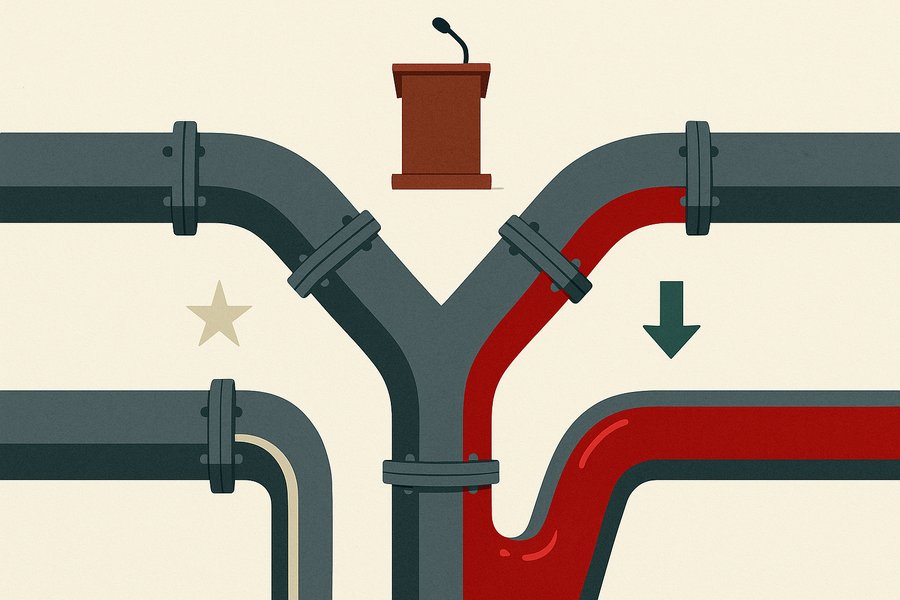
On Thursday, Treasury Secretary Scott Bessent stood at a White House briefing and announced that the artificial intelligence race was, in effect, over. "The US is the AI leader in the world," he said. "We're an AI superpower. China is second, they are trailing substantially." It was a confident line, repeated almost verbatim across global wires within hours. The trouble is that on the same day Bessent was speaking, the people who actually build software with AI models were sending the majority of their traffic to Chinese ones.
The numbers come from OpenRouter, the multi-model gateway that closed a $113 million Series B this week led by Alphabet's CapitalG. In the week of 24 February, Chinese open-weight models accounted for roughly 61 percent of token volume among OpenRouter's top ten models. Through April, combined Chinese providers held about 51 percent of all platform traffic. Eighteen months ago that share was under 2 percent. Moonshot's Kimi K2.6 and Xiaomi's MiMo-V2.5-Pro now tie for the highest score among open-weight models on the Artificial Analysis Intelligence Index, sitting three to six points behind GPT-5.5, Claude Opus 4.7 and Gemini 3.1 Pro Preview. On the harder SWE-Bench Pro coding benchmark, Kimi K2.6 has, by its own measurement, edged past GPT-5.5.
The reason is not patriotism, and it is not benchmark leadership. It is arithmetic. MiniMax's M2.5 charges roughly thirty cents per million input tokens and $1.20 per million output. Claude Opus 4.6 charged $5 and $25 for the same volumes. For an agentic coding run that might invoke a model thousands of times overnight, that gap is not a footnote, it is a budget line. Reuters has separately reported that around 80 percent of US AI startups now use Chinese open-source models, and Airbnb is among those switching. Nine of the top ten open-weight models in global download counts are now Chinese.
What Bessent is partly right about is the frontier. The Stanford HAI 2026 AI Index puts the US-China model performance gap at 2.7 percent on raw benchmarks. American closed models still lead, and large enterprises in regulated industries still mostly route through Anthropic, OpenAI, Azure or Google Cloud. The 100-trillion-token study published with Andreessen Horowitz late last year put proprietary Western models at roughly 70 percent of total global API share. The bifurcation matters: the United States leads on capability and on regulated, high-stakes workloads, while China is winning the developer commons.
Europe is now trying to make a third claim on the same ground. In Paris this week Mistral packed the event space under the Louvre pyramid with executives from SAP, BNP Paribas, Accenture and CMA CGM. Chief executive Arthur Mensch repeated his warning to French lawmakers that Europe has roughly two years to build enough AI infrastructure to avoid becoming an American "vassal state." His cofounder Guillaume Lample emphasised that Mistral's open-weight strategy lets customers run models on their own infrastructure, the same data-sovereignty pitch that gives the Chinese open-weight labs their opening.
There is one fact that complicates the Chinese surge and no political slogan dissolves it. Under China's 2017 National Intelligence Law, every Chinese AI lab must "support, assist and cooperate" with state intelligence requests. The US House Committees on Homeland Security and on China announced a joint investigation in April into the national security risks posed by Moonshot, MiniMax, Alibaba and DeepSeek, naming Anysphere's Cursor and Airbnb among the American firms building on Chinese infrastructure. Sovereign data exposure is a legal condition, not a configuration setting.
Put the three frames together and the global picture is sharper than any single headline. The United States leads on frontier capability, China leads on developer routing, Europe is racing to matter. A Treasury Secretary can keep saying America is winning, and the statement can hold for the workloads that pay the highest margins. But for the agentic coding runs that are quickly becoming the dominant shape of AI usage, the lead is already gone.