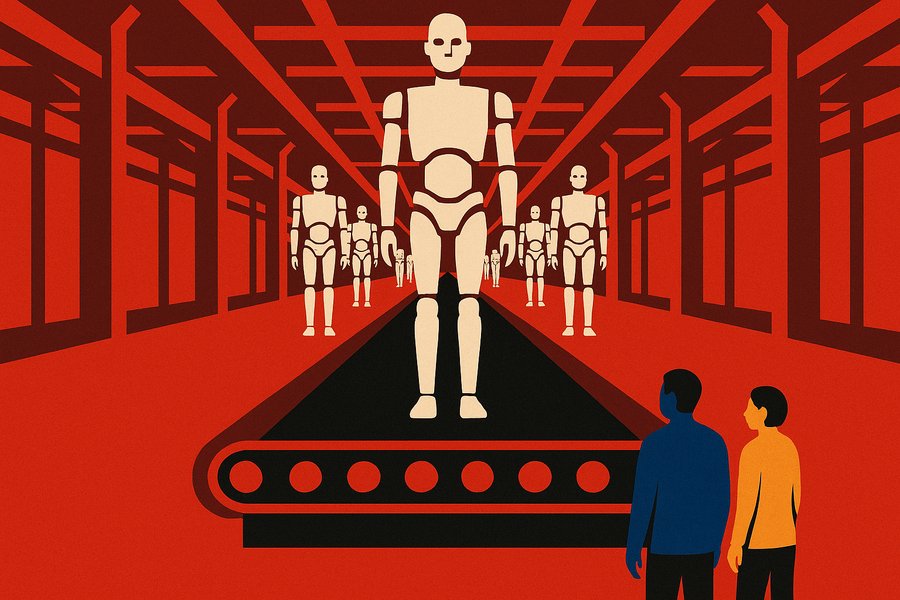
Somewhere in Shenzhen this week, a Chinese company called ENGINEAI flipped the switch on a factory that, it claims, can finish a humanoid robot every fifteen minutes. Each unit passes 79 inspections and 46 simulation tests before it leaves the floor, and the firm is aiming for 10,000 of them. A second line of the same size is going up in Zhengzhou. That cadence, more than any single dancing demo, is the real news in robotics right now. The industry has quietly stopped asking whether humanoids can work and started asking who can build and ship them in bulk.
On that question the scoreboard is lopsided. At the Seoul Forum this week, Persona AI strategist Michael Perry warned that "field-deployment capability, not technology, will decide the robotics race," and put China's share of the humanoid market at 78 percent. The numbers underneath that claim are piling up fast. XPENG says it will mass-produce its IRON humanoid by the end of 2026 and station the machines in its showrooms as sales assistants from early 2027, all on a fully in-house stack of chips, joints and operating system. BYD will roll its seventh-generation robot into dealerships starting this month. Unitree shipped roughly 5,500 humanoids last year, and AGIBOT says it has now passed the 10,000-unit mark.
The West is not standing still, but its wins look different. Figure AI livestreamed one of its robots sorting packages for 200 continuous hours with no human intervention, a deliberate rebuke to the one-minute highlight reels the field is known for, even if the packages ran in a loop. Hyundai, which owns Boston Dynamics, has disclosed plans to deploy more than 25,000 Atlas robots across its own plants by 2028, roughly 83 percent of the robot's targeted output. That choice is strategic: a captive factory is also a captive data mine, and training data, not hardware, is the bottleneck everyone is now racing to fill.
Japan offers the cautionary tale. At the Humanoids Summit in Tokyo, the dexterous hands and dancing machines that drew crowds were increasingly Chinese, from Booster Robotics to LimX Dynamics to a cute, $5,500 model from High Torque. One author at the event invoked the "Galapagos syndrome," the pattern in which beautifully engineered Japanese products evolve in isolation and never translate into mass-market scale. Honda showed a robotic hand that can thread a needle; the open worry was that finesse alone no longer sets the pace when a rival can stamp out copies cheaply.
Two signals suggest how serious Beijing is treating all this. China is now assigning national digital identity numbers to humanoid robots across their whole lifecycle, and has already tagged some 28,000 machines spanning about 200 models, a tracking regime that reads less like product registration and more like industrial policy. And Goldman Sachs has told clients that AI's next leg is shifting "from chips to humanoid robotics," framing it as an early-cycle chance to ride a multi-year rotation of capital into the sector. The catch, buried in the investment notes, is that most humanoids shipped so far have gone to research and education labs, not paying commercial customers. The factories are real, the cadence is real, and the open question is whether the buyers will arrive as quickly as the robots.