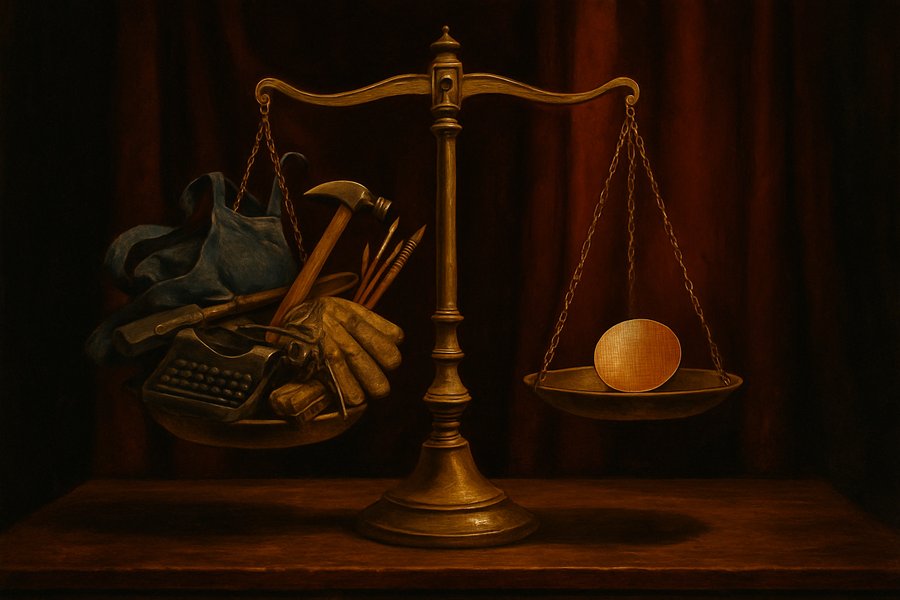
Pope Leo XIV released his first encyclical this week, titled Magnifica Humanitas, and the subject was not migration, war, or climate. It was artificial intelligence. The document, summarised across the weekend by Business Insider and Forbes, frames the displacement of human work by algorithms as the central moral question of the era, and warns that the dignity of labour itself is being quietly redrawn by people who never explicitly chose to redraw it. What makes the moment unusual is not only that a pope wrote about AI. It is who he asked to help him understand it.
According to Forbes, the lab the Vatican consulted most closely during the drafting was Anthropic. Its billionaire cofounder Dario Amodei was at the public release, alongside cardinals and ethicists. OpenAI was not. Google was not. The Pontifical Academy for Life has been holding closed meetings on AI for more than a year, and Anthropic representatives reportedly attended several of them. The encyclical does not endorse any company by name, but the choice of who was in the room shapes which framings made it onto the page.
That matters because the document leans heavily on a vocabulary Anthropic has spent two years promoting: alignment, oversight, the idea that the most capable systems carry the heaviest responsibilities. Pope Leo calls AI job losses a coming "moral imperative of historic proportions" and asks who exactly will absorb the cost when productivity rises but employment does not. Business Insider's read of the encyclical highlights three takeaways: a call for binding international rules rather than voluntary corporate pledges, a defence of workers in coding and creative fields whose tasks are being automated first, and a warning against treating AI development as an exclusively private enterprise.
The pick of Anthropic as moral interlocutor is striking for a second reason. Anthropic is the lab whose entire founding story is a schism with OpenAI over safety. Choosing it confers a kind of religious legitimacy on that schism. Forbes called this "the story" of the encyclical, more than anything in the text itself: an institution two thousand years old is implicitly saying that within the AI industry there is a side closer to the truth, and that side is not the one with the largest market share.
This is a fragile gift. Anthropic, like every frontier lab, also ships products that compete on speed, on capability, on agentic autonomy. Its researchers have publicly worried about the same dynamics the Pope is now formally condemning. The company benefits commercially from being seen as the conscientious option, which is precisely the conflict of interest the encyclical asks readers to notice in tech firms generally. If the Vatican wanted a neutral voice it could have picked academic ethicists. It picked an operating company instead.
There is a wider context too. The same week, Anthropic's Chris Olah, one of the field's most respected interpretability researchers, gave an interview arguing that AI oversight cannot be left to a handful of companies, however well-intentioned. Andrej Karpathy, the OpenAI co-founder turned independent, has signalled his next bet is on the Anthropic side of the alignment debate. A Vatican encyclical, a public defection, and a senior researcher's call for outside scrutiny are not coordinated, but they rhyme. They share a premise that the next phase of AI cannot run on industry self-regulation alone.
The open question is whether any of this translates into policy. Encyclicals carry enormous moral weight inside the Catholic world and are read carefully by governments in Europe and Latin America, but they do not write legislation. The AI Act in Brussels is already drafted. Washington is debating preemption rather than expansion. What Magnifica Humanitas may do is shift the language used in those debates. A bill that talks about productivity gains and competitiveness sounds different after a global moral authority has reframed the same numbers as a story about who, exactly, loses their job and what the rest of us owe them.
For Anthropic, the prize is real but double-edged. Sitting next to the Pope is the highest-status seat in the AI ethics conversation. It is also a seat that comes with expectations. The next time the company ships a model that automates a class of work, the encyclical it helped inspire will be read back at it, line by line, by people who took the moral framing at face value.