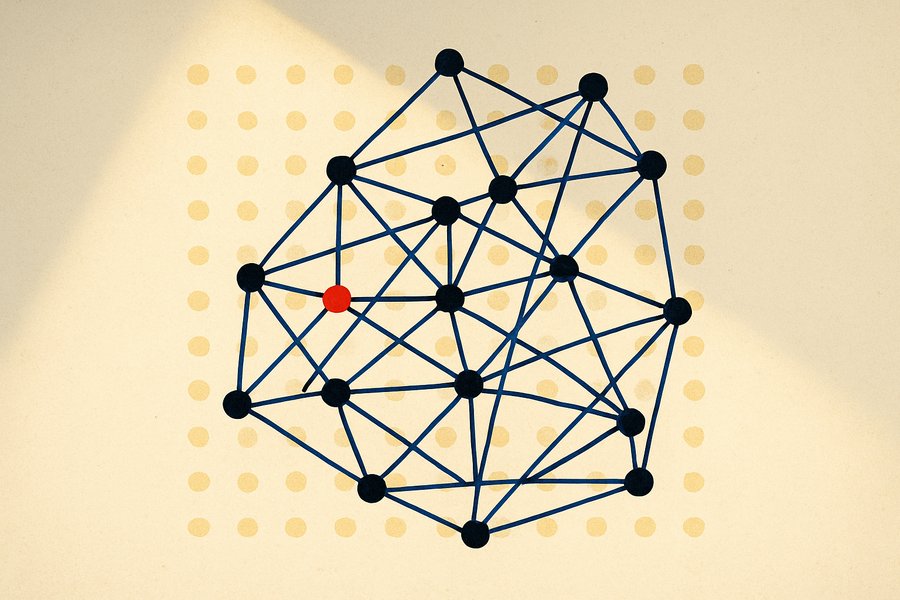
Draw some dots. Try to make as many pairs as possible sit exactly one inch apart. For 80 years, mathematicians believed the best you could do, as the number of dots grew, was a carefully spaced square grid. Last week, that belief stopped being true. An unnamed OpenAI reasoning model, working from a single open-ended prompt, produced a 125-page chain of thought that disproves the Erdős unit distance conjecture and exhibits a new family of point arrangements that beats the grid by a genuine polynomial margin.
The result was published on May 20, accompanied by a 19-page verification paper signed by nine mathematicians, including Fields Medalist Tim Gowers, Noga Alon, Thomas Bloom, Daniel Litt, Will Sawin, Jacob Tsimerman and Melanie Matchett Wood. Gowers told reporters that no prior AI-generated proof had come close to the standard of a top journal. Litt, who helped verify it, called it "the first result produced autonomously by an AI that I find interesting in itself."
That last phrase is the one to dwell on. Plenty of AI systems have touched serious mathematics before. Google DeepMind's AlphaProof reached silver-medal standard at the 2024 International Mathematical Olympiad, and Gemini Deep Think hit gold in 2025. AlphaEvolve improved the known lower bound for the kissing number in 11 dimensions last year. In January, GPT-5.2 cleared three open Erdős problems formalised in Lean. What makes this different is the combination: a well-known, much-attacked problem, solved by a general-purpose model that was not specialised for mathematics, autonomously, from one prompt.
The most surprising part is the route the model took. Generations of geometers tried to attack the unit distance problem with discrete geometry and combinatorics, and got nowhere. The AI reached instead for algebraic number theory, a branch with no obvious connection to dots on a page. It built a high-dimensional lattice with special internal symmetries, then mapped that structure back down to two dimensions, calling on heavy machinery such as infinite class field towers and the Golod-Shafarevich theorem to prove the exotic number systems it needed actually exist. The resulting arrangement is, mathematicians say, too intricate to draw on paper even for a small number of dots.
OpenAI's own mathematician Sébastien Bubeck stressed the framing: "The model did not invent something fundamentally new that nobody saw coming. It just executed like an amazing mathematician." Wood went further. She said that if the experts who later parsed the model's answer had instead spent that effort hunting for a counterexample, they probably would have found one themselves. And within hours of the announcement, Princeton's Will Sawin posted a sharper, explicit version of the lower bound, the kind of follow-up that suggests the door had been waiting to be opened.
There are caveats worth keeping in view. No outside expert saw the model's raw output, only an edited version. The AI did not find the optimal arrangement, only a better one. The proof needed human hands to become publishable. And OpenAI has not named the model, released the full 125 pages, or shared training details, which is why every verifier has been careful to call this a verified claim rather than an open result.
There is also a recent memory to manage. Last October, OpenAI's then-VP Kevin Weil announced on X that GPT-5 had solved ten previously unsolved Erdős problems. It had done no such thing; it had run a literature search and surfaced solutions the community had not catalogued. Thomas Bloom, who maintains the Erdős problem database, called the post a dramatic misrepresentation. The post was deleted; rivals piled on. This time, Bloom signed the verification paper. That is not an accident.
The honest summary: an AI replaced no mathematician this week. It became, briefly and verifiably, a startlingly capable collaborator. For everyone watching where reasoning models are headed, that distinction is the whole story.