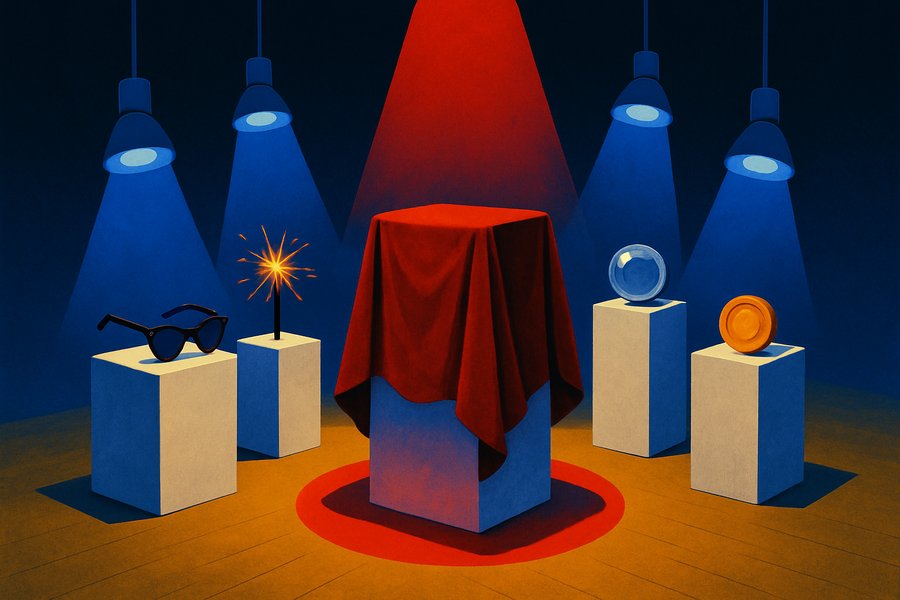
Sundar Pichai walked onto the Shoreline Amphitheatre stage on Tuesday with an ambitious slate and one missing item. Google I/O 2026 introduced a 24/7 personal AI agent called Gemini Spark, a new fast-and-cheap model called Gemini 3.5 Flash, a redesigned Google Search powered by agents, a hundred-dollar AI Ultra subscription tier and a partnership with Samsung on consumer "intelligent eyewear". What it did not introduce, despite widespread expectation, was Gemini 3.5 Pro, the company's next frontier model. The audible groan from the audience when Pichai asked them to "give us until next month" was the conference's most candid moment.
The headline numbers Google offered were extraordinary. Monthly token processing across Google products has grown from 9.7 trillion two years ago to 480 trillion last year to 3.2 quadrillion today, a seven-fold jump in twelve months. The Gemini app has more than doubled to 900 million monthly active users, while AI Overviews in Search has 2.5 billion and AI Mode has crossed one billion. Capital expenditure is expected to reach between $180 and $190 billion this year, roughly six times the 2022 level. By any measure, Google has converted its AI investment into mainstream consumer usage at a scale none of its rivals can match.
The product that best captures Google's new strategy is Gemini Spark. Unlike a chatbot, Spark runs continuously on virtual machines in Google Cloud, performs long-horizon tasks without the user keeping a laptop open, and integrates across Gmail, Calendar, Docs, Sheets and, in time, third-party tools via the Model Context Protocol. The first beta rolls out next week to subscribers of the new $100-per-month AI Ultra plan. The pitch is that Google's edge in the agentic era will come from the fact that it already owns the digital surfaces an agent needs to act on: inbox, calendar, browser, phone, maps. Competitors must integrate; Google merely connects.
Gemini 3.5 Flash, the model that actually shipped, is more interesting than its marketing suggests. Google is positioning it as a frontier-capable model at roughly half the price of comparable rivals, four times faster on output, and the new default for the Gemini app and Search. Pichai claimed that 80 percent of top-end workloads could shift from larger models to Flash and save more than a billion dollars a year for the heaviest enterprise users. That framing is significant. It echoes the strategy China's open-weight providers have used to undercut Anthropic and OpenAI on enterprise agentic workloads, and signals that Google sees the inference economy, not the parameter race, as the next battleground.
Which makes the missing Pro model the more revealing story. Business Insider's reporter on the ground noted that three developers at the conference all said Google still lags Anthropic's Claude Code and OpenAI's Codex on the coding tasks that have become the most lucrative front of the AI race. One plausible reading of the delay, floated in the same piece, is that Google is using its Antigravity coding platform, now running on 3.5 Flash, to harvest reinforcement-learning signal from millions of real developer sessions and feed it into 3.5 Pro before release. Coding generates unusually clean reward signal: the code works, or it does not. If true, the delay is less a stumble than a deliberate trade of timing for quality.
The rest of the keynote leaned heavily into the same theme of AI as ambient infrastructure rather than discrete product. Search is being rebuilt around "information agents" that work in the background and can generate custom dashboards or mini-apps inside results pages. Gemini Omni, a multimodal world-model family, lets users edit video by conversation. Maps, YouTube, Docs and Gmail are gaining voice-first AI experiences. Audio glasses developed with Samsung will arrive in autumn, with display glasses to follow. Demis Hassabis told the room humanity is standing "in the foothills of the singularity", a phrase one audience member reportedly photographed for posterity. For now, Google's challenge is more modest: ship the Pro model on time, and keep the lead in coding from drifting any further.