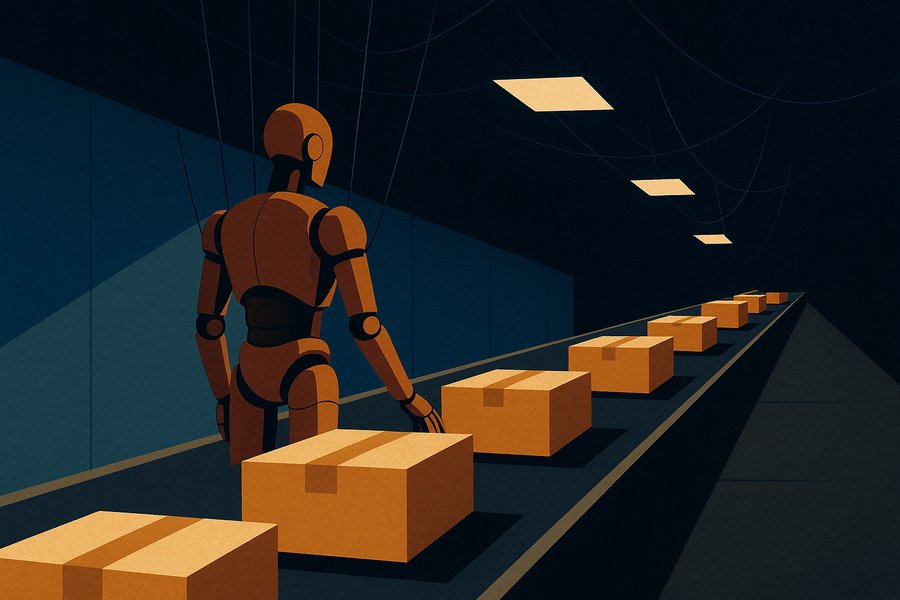
The livestream was meant to last eight hours. On the fourth day, it was still going. Figure AI had placed a single humanoid robot, named Jim, in front of a warehouse conveyor belt with instructions to sort packages. When the demo clock ran out, Jim kept working. The company decided to keep broadcasting. By the time they finally stopped the stream, Jim had processed more than 101,000 packages over 81 hours, at roughly one package every three seconds, without a bathroom break, a meal, or any visible sign of slowing down.
The claim was bold: Figure AI's proprietary "Helix-02" AI system had made every sorting decision autonomously, with no human hand on the controls. That is the part that viewers immediately set about disproving.
On social media, clips from the stream spread fast and criticism followed close behind. Multiple users on X identified a moment where Jim appeared to touch its own head in a way that looked unsettlingly human -- the instinctive gesture of someone adjusting a virtual reality headset. Some viewers flagged hand movements they said were too fluid, too deliberate, too organic to be purely machine-generated. "Caught them swapping controllers," read one viral post. "This is someone in a VR suit," went another. Figure AI did not confirm any remote assistance during the stream. The company continued presenting the demonstration as evidence of genuine autonomous capability.
A separate, more directly competitive test offered a different kind of data. Figure AI organized a ten-hour "Man vs. Machine" challenge: a human intern sorted packages on a conveyor belt, head-to-head against the Figure 03 robot, for ten continuous hours. The human finished with 12,924 packages processed at an average speed of 2.79 seconds each. The robot managed 12,732 at 2.83 seconds. Margin of victory: 192 packages. The intern reportedly emerged with his left forearm "basically broken." The robot showed no fatigue and kept sorting after the challenge ended.
Figure AI CEO Brett Adcock marked the outcome with characteristic precision. "Congratulations to Aime!! He said his left forearm is basically broken." A little later, he added: "This is the last time a human will ever win." It is the kind of framing that invites the follow-up question: if the robot's long-term advantage is this inevitable, why is the company staging demonstrations at all?
The skepticism around the 81-hour stream touches something larger than one company's marketing. AI robotics demonstrations have been scrutinized for years -- every polished video is now examined for jump cuts, camera angles, or signs of off-screen assistance. Boston Dynamics has faced similar questions. Tesla's Optimus demos have attracted similar frame-by-frame dissections. The question the Figure AI stream raised is not just whether this particular robot was autonomous. It is whether the industry as a whole has built enough demonstrated trust with the public to make such claims land without immediate suspicion.
On the technical merits, most robotics researchers acknowledged that sustained multi-hour industrial operation is genuinely difficult: battery management, consistent object recognition under variable lighting, error recovery, stable motion control across thousands of repetitions. These are real engineering achievements. But "technically impressive" and "fully autonomous" are not the same assertion, and the gap between them is precisely where the online debate lives. A demonstration designed to show the world what AI can do became, instead, a global exercise in working out whether the demonstration was real.