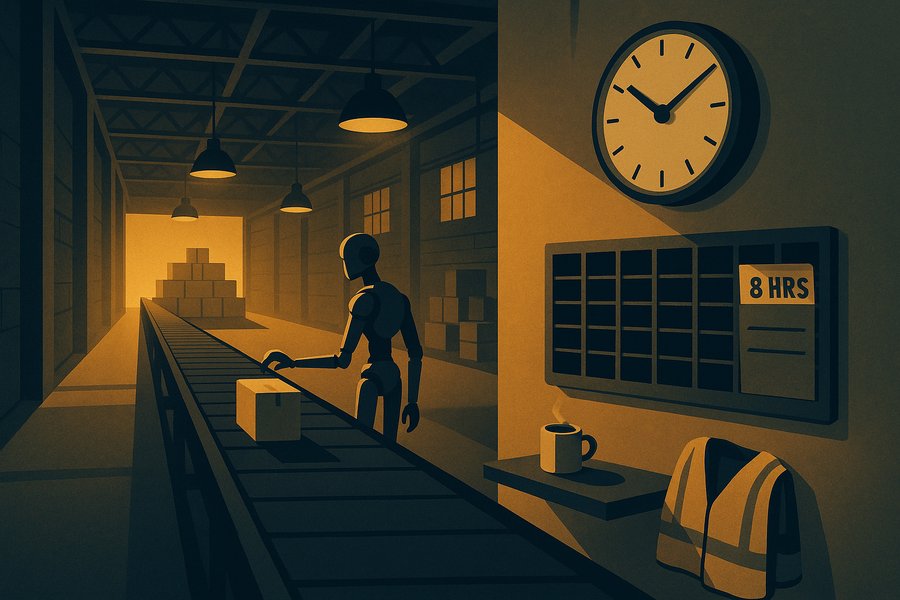
On Tuesday, Figure AI CEO Brett Adcock posted a video to X that, if taken at face value, represents something genuinely different. "Watch a team of humanoid robots running a full 8-hr shift at human performance levels," he wrote. "This is fully autonomous running Helix-02." Across the eight-hour livestream, Figure 03 robots sorted barcoded packages onto a conveyor belt at around three seconds per package -- the same pace, Adcock said, as an average human doing the same job. The comparison was not incidental. It was the whole point.
For years, the standard critique of humanoid robot demos was endurance. A robot that can stack boxes for ninety seconds in a controlled environment tells you relatively little about whether it can hold up through an actual shift. Figure AI's earlier Helix demonstrations had run for about an hour. Tuesday's test pushed that to eight. The company designed the demonstration specifically around the failure problem: multiple robots were networked together with an autonomous failover system. If one robot detected a malfunction, it would walk itself to a maintenance area and request a replacement from the fleet -- no human intervention required. The conveyor stayed moving.
What makes Helix-02 technically distinct from earlier robotic systems is the absence of the usual division between planning and motion. Traditional industrial robots run separate controllers for navigation and manipulation; Helix-02 fuses vision (from head cameras and palm cameras), touch (fingertip tactile sensors), and full-body proprioception into a single neural network that outputs joint movements across all 35 joints simultaneously. The company calls the underlying motion layer "System 0" -- a learned controller trained on over 1,000 hours of human motion data that replaces more than 109,000 lines of hand-coded control software. All inference runs onboard; there is no cloud connection. The robot does not call home.
The same week, a smaller but in some ways more consequential story emerged from the UK. Humanoid, a robotics startup founded in 2024 by Artem Sokolov, announced a binding, phased deployment agreement with Schaeffler, the German industrial components manufacturer. The deal covers the deployment of 1,000 to 2,000 wheeled humanoid robots across Schaeffler's global facilities by 2032, with the first systems going live in Germany before the end of 2026. The initial tasks are modest: box handling in Herzogenaurach and near-full-scale factory testing in Schweinfurt. But the contract structure is notable. It is a Robot-as-a-Service arrangement, with Humanoid providing not just the machines but the fleet management software, maintenance, and integration support. Schaeffler, in turn, will become Humanoid's preferred supplier for joint actuators through 2031, covering at least one million actuators over the period. Both companies are now financially entangled in each other's success.
Together, these two stories mark a shift in the conversation. The question is no longer whether humanoid robots can perform factory tasks under ideal conditions. Figure AI answered that a year ago. The new questions are harder and more practical: Can a robot sustain performance for a full shift? What happens when something breaks? Who absorbs the cost of integration? The autonomous failover system in Figure's demo, and the RaaS model in Humanoid's contract, are both attempts to answer those questions in the affirmative. Whether they hold up in actual production environments -- with the unpredictability of real factory floors, real supply chains, and real workers watching -- is what the next few years will determine.
For workers in package handling and warehouse logistics, Tuesday's demonstration was harder to watch than most robot demos, precisely because the comparison to human performance was made explicit and was plausible. Human warehouse workers average around three seconds per package. So, now, do the robots -- and they do not take breaks.