The data for April 2026 has arrived, and it shifts the AI employment debate from speculation to evidence. According to outplacement firm Challenger, Gray and Christmas, US employers announced 83,387 job cuts last month, a 38 percent jump from March. Of those, 21,490 — roughly one in four — were officially attributed to artificial intelligence. For the second consecutive month, AI was named the leading single cause of workforce reductions in the United States.
These numbers land in the middle of a broader story. More than 92,000 tech jobs have been cut in the first five months of 2026 alone, with AI cited across a significant share. The pattern inside individual companies reveals the underlying logic: Meta announced 8,000 layoffs in April while simultaneously committing $135 billion in AI capital expenditure. Snap reduced 16 percent of its workforce after its CEO noted that AI now writes more than 65 percent of the company's code. Each decision is presented as rational cost management. Together, they describe a structural shift in how technology companies are staffed.
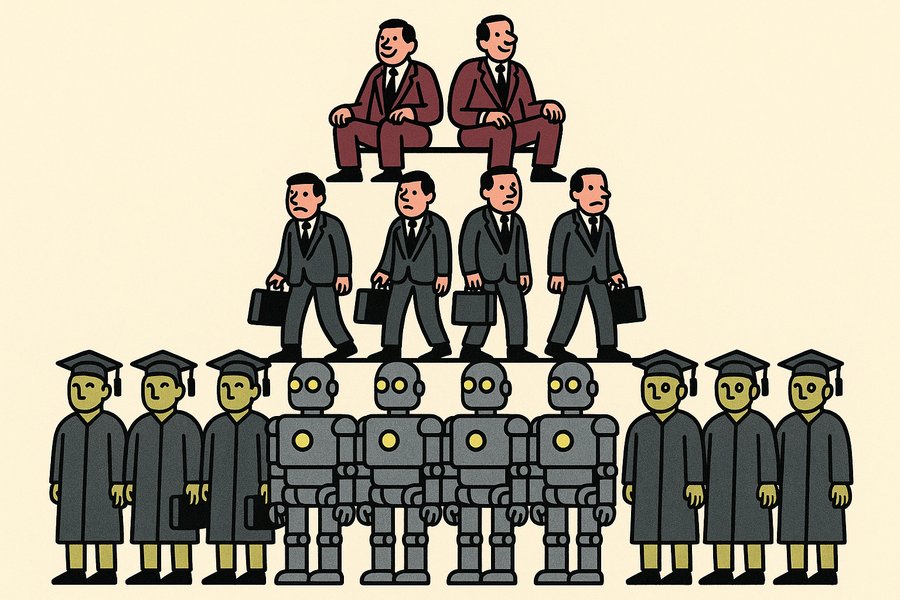
The clearest structural illustration of what is happening comes from the legal profession. MinterEllison, one of Australia's largest law firms, cut its graduate intake by nearly a third, from over 100 positions to 72, becoming the first major firm to explicitly say AI is the reason. The traditional law firm model depended on a pyramid: partners at the top, junior associates at the base handling document review, basic research, and discovery work. That base is now being handled by AI tools. When the routine work disappears, the need for the people who did it disappears with it. Herbert Smith Freehills, Allens, Mallesons, and Norton Rose Fulbright are making similar cuts while offering softer explanations. MinterEllison broke from the polite fiction.
The question of what this means historically is sharply contested. Apollo chief economist Torsten Slok drew a comparison this week to the "China shock" of the early 2000s, when China's WTO entry eliminated roughly four million US manufacturing jobs over two decades. His conclusion: the AI shock will follow the same playbook. Disruption, productivity gains, new industries, net positive outcome. "Just as cheaper Chinese inputs helped US businesses grow and hire," he wrote, "AI is already accelerating business formation and productivity gains across the economy." The China shock, after all, did not produce the mass unemployment its critics predicted.
David Autor, one of the economists who coined the "China shock" term, accepts the parallel but draws the opposite lesson from it. The China shock was experienced by specific regions and sectors: Midwestern factory towns, Southern textile communities, places with economies tied to a single industry. It was geographically concentrated, which made it politically visible and, to some degree, policy-addressable. AI is different: it targets job functions, not geographies or industries. Document review disappears from law firms and from any organisation that relies on it. Basic coding assistance disappears from junior developers across every sector. The displacement is diffuse, affecting every industry simultaneously, and that diffusion makes it harder to measure, harder to respond to with targeted policy, and harder for any particular community to organise around.
There is also an important asymmetry in how the productivity gains flow. When cheap Chinese manufacturing inputs reduced the cost base for US manufacturers, those savings could be reinvested in production and wages within the US economy. When AI replaces a paralegal, the firm saves the cost of that role and captures the saving as margin. The displaced paralegal earns nothing and buys less. At scale, this pattern does not simply redistribute income; it begins to shrink the pool of income available to be spent.
The law firm pyramid is a useful frame not because lawyers are uniquely vulnerable, but because the profession's structure makes the mechanism visible. The entry-level work was never the destination; it was the training ground for judgment that takes years to develop. Remove the entry-level work and you do not just cut some jobs: you cut the pipeline that produces the senior professionals the firms will still need. How MinterEllison replaces that pipeline is a question the firm has not yet answered publicly.