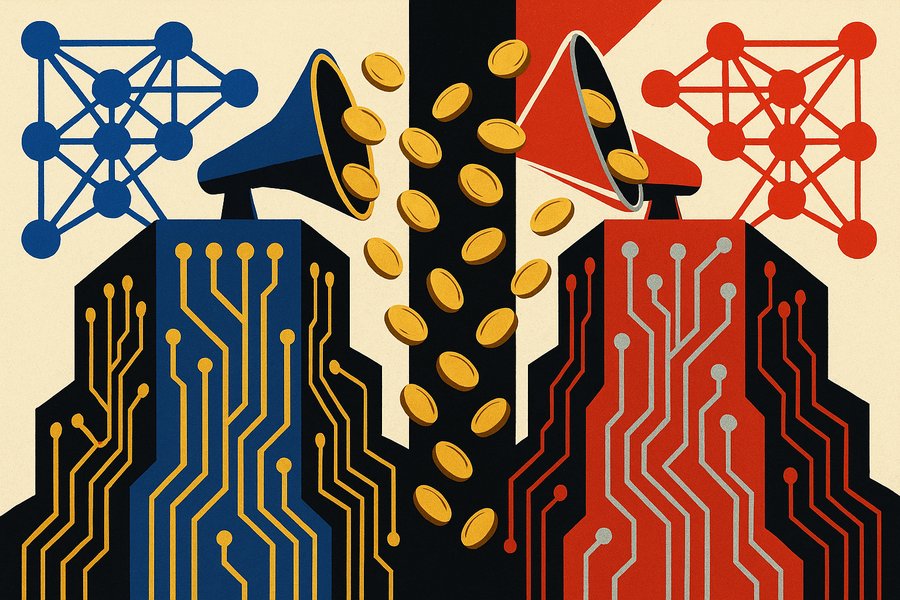
The videos appeared in feeds across the United States in late 2025 and have kept coming since: travel bloggers, lifestyle creators, and mom influencers explaining, with practiced concern, that China is on the verge of winning the AI race and that America needs to wake up. The creators look sincere. The scripts were written for them. The payments of up to $5,000 per video cleared before the uploads.
The campaign is called Build American AI, run through a nonprofit affiliated with the lobbying group Leading the Future. It raised $125 million in 2025 and still held roughly $70 million at the start of 2026. The donors include OpenAI President Greg Brockman and his wife ($25 million of personal funds), venture capital firm Andreessen Horowitz ($25 million), Palantir co-founder Joe Lonsdale, and Perplexity investor Ron Conway. Both OpenAI and Palantir have distanced themselves on the grounds that the donations were personal rather than corporate. The distinction holds up in a filing cabinet. It is harder to maintain in the real world.
The campaign's structure is deliberate. Phase one offers positive messaging about AI improving everyday life. Phase two shifts to fear: China will steal your data, take your job, threaten your children. Creators receive ready-made scripts and post under their own names, lending the campaign the authenticity of independent opinion while delivering messages written by lobbyists.
The timing is not random. American AI companies are facing genuine domestic headwinds. Local activists have blocked data center projects worth $64 billion. Maine became the first US state to impose a moratorium on large data center construction until 2027, with Pennsylvania considering similar action. The opposition has come from both conservatives (energy use, land, environment) and progressives (the same concerns, plus worker displacement). The industry needed a frame that cast this resistance as something other than legitimate local objection. It found one in China.
The underlying competitive picture is real but more nuanced than the campaign suggests. More than 600 million users in China engaged with generative AI tools by the end of 2025, a 142 percent increase year on year. DeepSeek's efficiency breakthrough in late 2024 genuinely rattled American confidence. The US government's own evaluation unit, CAISI, released a formal assessment on May 1 finding DeepSeek's flagship model lagged the American frontier by about eight months.
Independent researchers read the methodology and started asking questions. Stanford's 2026 AI Index found the US-China performance gap on public leaderboards had collapsed to 2.7 percent. CAISI's assessment used an Item Response Theory scoring system applied across nine benchmarks, two of which were private and unverifiable. Its cost comparison excluded all US models it deemed too expensive or too weak, leaving only one American model for comparison, against which DeepSeek was still cheaper on five out of seven benchmarks. The report may be accurate in its conclusions. It is not without critics who have read it closely.
Both things are true simultaneously: China has a serious and growing AI industry, and American AI companies have a strong financial interest in making it sound more threatening than it is. The China frame serves specific commercial purposes. It repositions data center opposition as anti-American. It converts future government investment in American AI companies from corporate subsidy into national security spending. And it redirects public attention from a more uncomfortable domestic question.
That question is this: the companies funding the Team USA campaign are also among the most aggressive deployers of AI automation in American workplaces. The productivity announcements, the quarterly reports celebrating head count reduction, the legal research and financial analysis and software work that AI is absorbing, all of it runs on systems developed by companies headquartered in Palo Alto and Seattle. If a Chinese model displaces an American worker, it is a national security crisis. If an American model displaces an American worker, it is innovation and efficiency. The worker does not experience these outcomes differently. The geographical origin of the automation does not change what the automation does to the person who loses the work.
Foreign Affairs observed this week that Trump's trade and technology policy has functioned as a trap: pushing traditional American allies toward Beijing, fragmenting the international relationships that actually constrain China's technological ambitions. The encryption wars of the 1990s offer a precedent. American companies were hobbled by export controls. Adversaries developed their own capabilities regardless. The mathematics could not be embargoed. The US got worse technology sector outcomes and no meaningful containment.
The Team USA campaign is not making an argument about how AI should develop. It is making an argument about how the public should feel about AI: associate Chinese AI with threat, associate American AI with safety and national interest. Neutralize domestic resistance by recasting it as geopolitical vulnerability. The influencer videos are not informing a public debate. They are manufacturing the terms on which the public will have it.