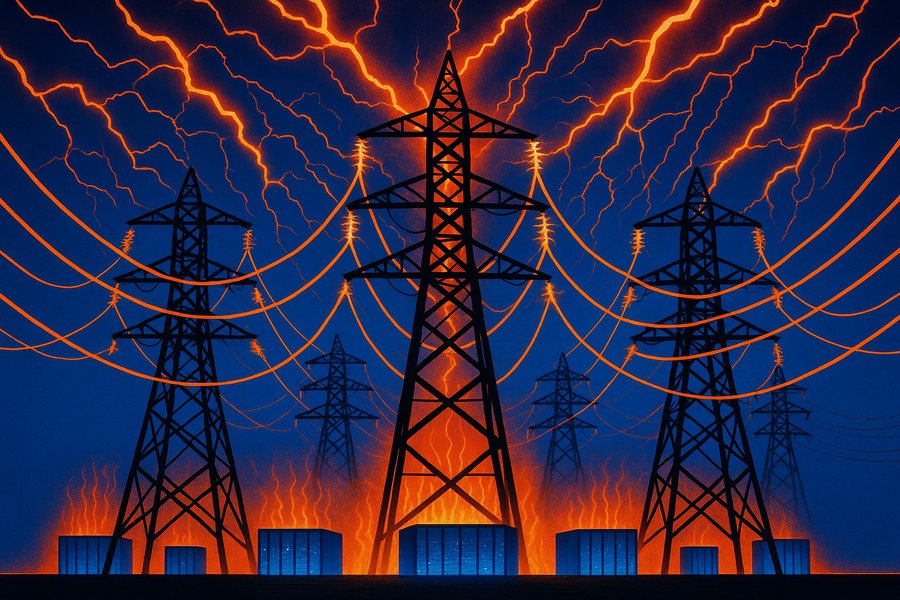
North America's grid security monitor has just issued only its third Level 3 alert in history. The cause is not a natural disaster or a geopolitical shock. It is artificial intelligence.
The North American Electric Reliability Corp., the nonprofit body that oversees grid security across the United States and Canada, released the highest-severity warning in its playbook this week, citing the growing threat from AI data centers to bulk power system stability. Level 3 alerts are extraordinarily rare, and this one comes after a series of troubling incidents where data centers abruptly disconnected from the grid, creating massive, sudden load swings that the system was never designed to absorb.
The starkest example occurred in Virginia in July 2024, when a routine equipment failure caused data centers to yank more than one gigawatt of power off the grid in an instant, switching to backup generators to protect their cooling systems. A gigawatt is enough electricity to power roughly 750,000 homes. "The electric grid has not historically experienced simultaneous load losses of this magnitude in response to a fault on the system," NERC said. As AI infrastructure continues to scale, "the risk for frequency and voltage issues also increases." A paper from researchers at Nvidia, Microsoft, and OpenAI had already warned that AI power swings can cause physical damage to grid equipment.
The rules of the road have not kept pace with what is being built. Unlike power plants, data centers are not currently required to notify grid operators when they come online or go offline, or to report the sharp power swings that AI workloads generate. NERC's alert calls for seven essential actions, including detailed load modeling, annual grid stability studies in AI-dense regions, and fault recording equipment at data center sites. These are currently recommendations, not mandates. But NERC has signaled it plans to write binding reliability standards by year's end, with approval from the Federal Energy Regulatory Commission possible in 2027.
The scale of what regulators are trying to manage is staggering. The International Energy Agency projects that global electricity consumption from data centers will roughly double by 2030, with AI-focused facilities tripling their consumption over that period. The five largest tech companies alone spent over $400 billion on infrastructure in 2025, a figure projected to jump another 75% in 2026. That combined capital expenditure now exceeds total global investment in oil and gas production. Five Silicon Valley firms are outspending the entire fossil fuel extraction industry on infrastructure, and the grid they are plugging into was not built for this.
That collision is already reshaping energy investment. The American Action Forum reports that planned natural gas generation capacity surged 71% between 2025 and 2026, driven directly by AI data centers that need 24/7 reliable power. Natural gas can connect to the grid at roughly one-tenth the cost of solar or offshore wind, and its permitting timelines are shorter. Renewable capacity additions grew just 2% over the same period. The green energy commitments tech companies have made are running into the prosaic reality that the grid cannot deliver clean electricity on their preferred timeline.
The pressure is not confined to North America. A major new study by Interface, a European energy and digital policy think tank, found that data centers across Europe are running at half capacity because the electricity grid simply cannot feed them. Grid connection queues in some regions stretch a decade. The report warns that without urgent reform, Europe's AI ambitions could become costly stranded assets: facilities built and powered, but not competitive. "Constructing multi-hundred-megawatt facilities that fail to use their contracted capacity would be unsustainable not only economically but also from an energy and climate-system perspective," the study concluded.
There is also a quieter problem building inside corporate sustainability reporting. Many companies measure energy use intensity: consumption per unit of output rather than absolute consumption. A generative AI inference workload can consume ten times more electricity than a standard search query. As AI workloads scale, absolute consumption climbs even as intensity metrics continue to improve. The IEA estimates data centers could consume 20% of U.S. electricity by the end of the decade. Facilities teams are delivering on their efficiency programmes while a separate AI infrastructure team quietly erases those gains from the books.
NERC has asked the industry to respond to its recommended actions by August. The watchdog's alert is, in essence, a formal notice to an industry that has been building fast and asking permission later, that the rules of grid citizenship are about to become mandatory. Whether that regulatory timeline matches the pace of construction is the open question. One in five data centers planned for construction by 2030 may not connect to the grid on schedule, according to IEA projections. That is both a constraint on AI ambitions and, potentially, the pressure that finally forces the infrastructure catch-up the grid has needed for years.