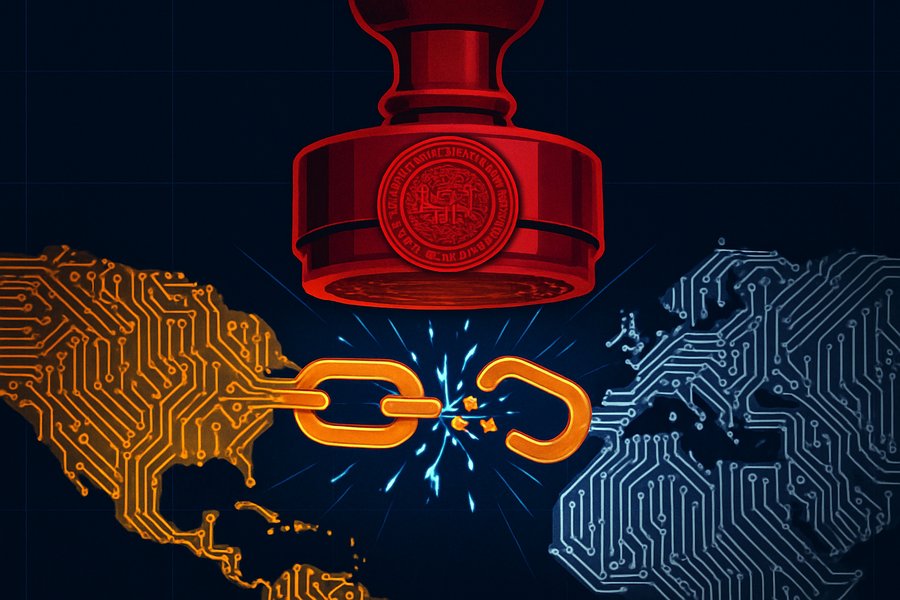
When Manus AI's founders moved their company to Singapore and sold it to Meta for $2 billion, it seemed like a clean exit: Chinese-born entrepreneurs building a global AI agent, taking Western capital, and landing on the right side of the geopolitical divide. Then Beijing said no.
China's National Development and Reform Commission announced this week that it was unwinding the acquisition after a three-month review. The agency cited laws and regulations without specifying which ones. The founders, Xiao Hong and Ji Yichao, had already been placed under exit bans earlier in the process. The message to the rest of the AI startup world was not subtle.
Manus itself had become a minor sensation when it launched last year. Unlike conversational chatbots, it was designed as an autonomous agent capable of completing multi-step tasks with minimal human direction. It claimed to have gone from zero to $100 million in revenue faster than any company in history. That kind of trajectory attracted American venture capital quickly, and Meta's interest followed. The $2 billion price tag was substantial for a company that was barely a year old.
What makes the story more complicated is that Manus had done everything a Chinese founder would reasonably do to navigate dual-jurisdiction risk. The company shut its China offices, cut off most of its Chinese users, and relocated its headquarters and core staff to Singapore. It was, by any ordinary measure, a Singapore company making a deal with an American buyer. Beijing disagreed with that framing.
The NDRC's decision is now cascading across the ecosystem. According to reporting from Business Times and other outlets, Chinese regulators have privately warned AI startups including Moonshot AI and StepFun to reject US-origin capital unless they receive prior government clearance. ByteDance was told that even secondary share sales to American investors require approval. In one case, a founder postponed a public funding announcement specifically to avoid scrutiny from officials who might see it as a Manus-style transfer of assets.
Several founders who spoke with journalists asked not to be named. One asked whether their company could be described as "Singapore-based" in coverage, as that framing would be "very helpful to growth." The request captures a new anxiety in the diaspora: Singapore incorporation no longer provides the separation it once implied.
There are two distinct stories running in parallel here. One is about a specific deal that failed, with specific people affected. The other is about what the Chinese government is willing to assert about companies founded by Chinese nationals, regardless of where those companies are headquartered and whose rules they are following. The NDRC has not published a clear legal theory, which may be precisely the point: ambiguity is its own enforcement mechanism.
For the global AI startup ecosystem, this introduces a new variable that is difficult to price. Founders with Chinese origins building outside China now face a question their predecessors in other industries rarely had to answer: at what point does your nationality become a jurisdiction? The Meta-Manus deal was not a grey area by any reasonable reading of cross-border commercial law. Beijing treated it as one anyway, and backed that treatment with tools it rarely used in public before: exit bans, deal reviews, and quiet warnings to other companies. Whatever the formal legal basis turns out to be, the practical result is already visible in the behavior of founders trying to avoid becoming the next cautionary example.