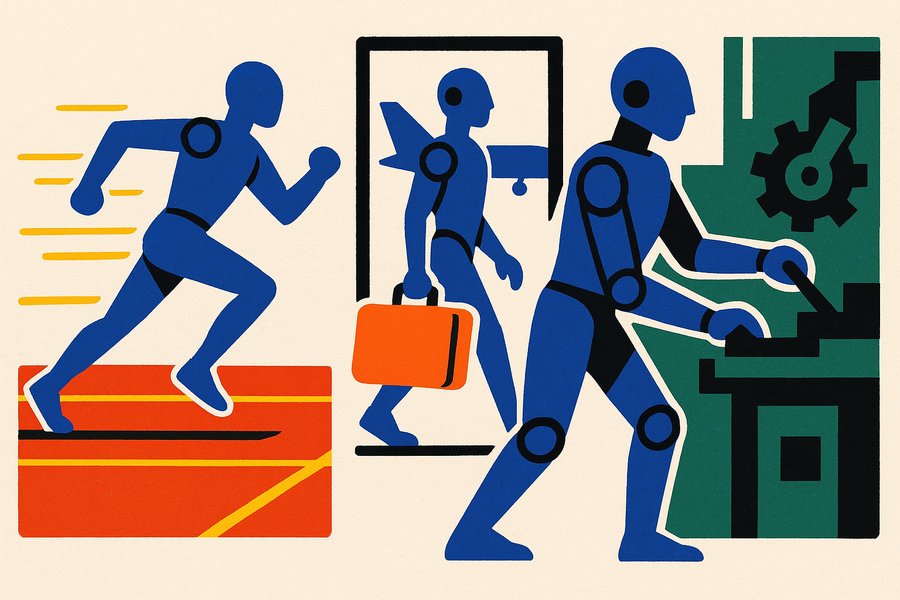
Three things happened last week that, taken individually, are remarkable. Taken together, they mark something like a phase shift. A humanoid robot completed a half-marathon faster than any human ever has. Japan Airlines announced it will deploy humanoid robots as baggage handlers at Tokyo's Haneda Airport, starting this May. And Siemens published results from a humanoid robot working autonomously on its factory floor in Erlangen, Germany, hitting its throughput targets over an eight-hour shift. The demo phase of humanoid robotics is ending. Something more consequential is beginning.
The racing result alone would have been striking in any previous year. The Honor Robotics D1 completed the 13.1-mile course at Beijing's E-Town Humanoid Robot Half-Marathon in 50 minutes and 26 seconds, beating the human world record of 57:20 by nearly seven minutes. A year ago, the winning robot in the same race finished in 2 hours and 40 minutes. The D1's aerodynamic design and a closed-loop liquid cooling system borrowed from smartphone engineering allowed it to sustain an average pace of roughly 15.6 miles per hour for the full distance. This is not a robot learning to jog; it is a robot learning to run at a competitive pace for sustained periods, autonomously, without human intervention during the race.
The airport deployment tells a different kind of story. Japan Airlines and its tech partner GMO Internet Group are not deploying robots because the technology is dramatically cheaper than human labour yet. The trial will run in carefully staged phases through 2028, with robots initially tested in simulated environments before taking on live operations. The driving factor is a structural one: Japan's ageing population is shrinking its workforce while inbound tourism continues to grow. Ramp work, the loading and unloading of aircraft, is physically demanding labour that is becoming harder to staff. Humanoid robots are attractive here precisely because they can operate in environments built for people, without costly redesigns of existing infrastructure. "This is likely to inevitably reduce workers' burden," said the president of JAL Ground Service, making the case carefully and in terms of benefit to remaining employees rather than replacement.
The Siemens results are perhaps the most practically significant. The HMND 01 Alpha robot, built using NVIDIA's physical AI stack, performed autonomous logistics tasks in a live factory setting: picking, transporting, and placing containers for human operators. It completed 60 tote moves per hour with better than 90 percent pick-and-place success over an eight-hour run. These are not aspirational benchmarks; they are measured performance in an operational environment. Siemens is integrating the robot into its broader factory automation infrastructure, including real-time data exchange with production systems and synchronized workflows alongside human workers.
At Hannover Messe in April, Neura Robotics CEO David Reger offered a framing that is increasingly common among robotics executives: the robot is not replacing people so much as filling positions that cannot be filled. He cited a projected shortfall of 101 million workers across China, Japan, and Europe by 2030. The humanoid form factor, he argued, is specifically suited to existing workplaces designed for human bodies: same height and reach, fits into existing production lines, no facility modifications required. What has changed this year is the move from demonstration to deployment at measurable scale. UBS analyst Phyllis Wang has forecast 30,000 humanoid robot units globally in 2026, with significant ramp in 2027 and 2028 as several manufacturers, including Tesla with its Optimus line, move toward production capacity in the hundreds of thousands.
What the week's news does not resolve is whether the "filling gaps" framing holds once the technology matures. Labour shortages are a persuasive entry point for robot deployment, and Japan's situation is genuine. But a robot trained to move luggage at Haneda is not permanently constrained to labour-shortage conditions. The same argument applies in manufacturing. The competitive dynamics of humanoid deployment suggest the question of whether robots are complementing scarce human labour or systematically replacing it will not remain stable as the technology scales.