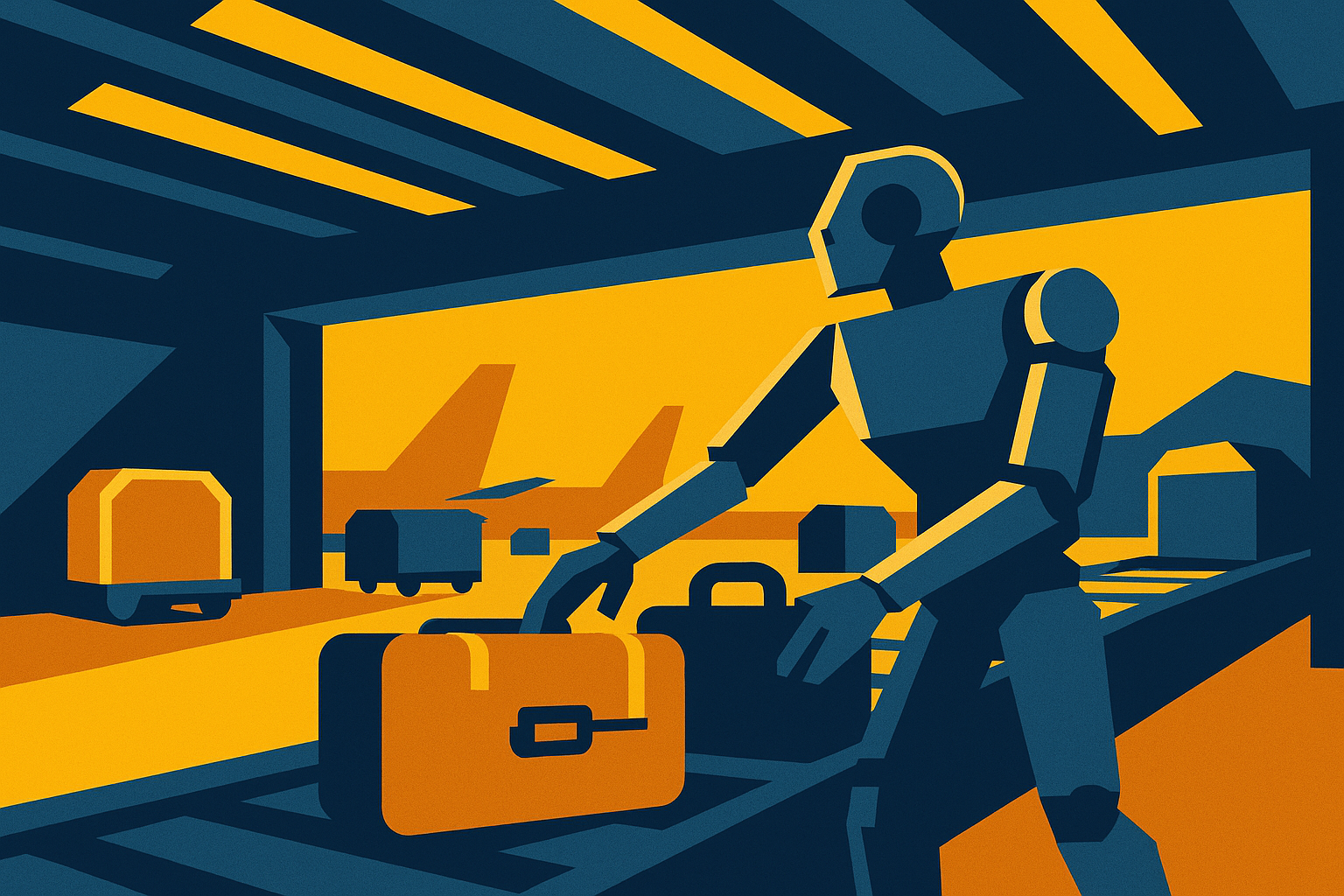
Japan Airlines has announced what it describes as the country's first demonstration trial of humanoid robots in airport operations: its ground handling arm will deploy human-shaped machines at Haneda Airport from next month through 2028, in a joint project with IT and robotics company GMO. The robots will handle cargo loading, baggage operations, and possibly cabin cleaning, tasks that have become increasingly hard to staff in Japan's tightening labour market.
The timing reflects a specific demographic squeeze. Japan's aviation industry is being hit by a collision of forces: an ageing workforce, declining numbers of young people willing to take physically demanding jobs, and a surge in inbound tourism keeping passenger demand high. Ground handling has always struggled with recruitment. The work requires specialist skills, involves heavy lifting in confined spaces around aircraft, and is not especially attractive to new entrants into the labour market. Adding conventional automation would typically require costly modifications to airport infrastructure. A human-shaped robot that can work in spaces already designed for people sidesteps that problem.
The trial will use two platforms: Unitree Robotics' G1, which stands 130 centimetres tall, and UBTECH's Walker E at 172 centimetres. Rather than putting them straight to work, the first phase will focus on mapping operations and identifying where humanoids can safely operate alongside existing staff and equipment. This caution reflects a wider pattern in how the industry is approaching real-world deployment: carefully, with a long runway.
A useful frame for understanding where humanoid robotics sits right now comes from an industry analysis this week comparing today's humanoids to commercial autonomous mobile robots from fifteen to twenty years ago. Back then, the sensors were expensive, the supply chains were thin, and every unit required significant hand assembly. Those constraints drove costs high and reliability low, and the transition to mass-scale warehouse deployment took many years of incremental progress. Humanoid robots are at an equivalent stage: the components, particularly the actuators and perception systems, are still largely custom or low-volume parts, which keeps costs elevated and reliability below what demanding operational environments require.
The contrast with mature industrial robotics is instructive. German startup Sereact, which raised $110 million this week for its warehouse AI platform, reports one human intervention per 53,000 pick operations across 200 commercial deployments. That performance level came from training on over a billion real-world picks, not simulated data. The company's co-founder explicitly attributes this to a data flywheel built from production deployments, not laboratory conditions. Humanoid robots in ground handling are nowhere near that baseline yet, which is precisely what trials like the Haneda project are designed to start measuring.
The honest framing is that this is an extended experiment to find out what the gap looks like in practice. Airport ground handling introduces variables that are hard to replicate in a controlled environment: aircraft moving nearby, weather, time pressure, the specific choreography of baggage systems. A robot that performs well in a demonstration is not necessarily the same robot that performs well through a twelve-hour operational shift, in rain, with flight schedules running late. The two-year timeline exists because figuring out these specifics takes time.
Japan's specific labour pressures make it a natural first mover for these trials, but the underlying question is universal. Humanoid robots are being positioned as a flexible labour solution for the demographic pressures that many advanced economies are already feeling. Whether the technology matures to meet that positioning in a meaningful timeframe depends less on the AI inside the robots and more on whether the industrial ecosystem around them, the supply chains, the safety certification processes, the manufacturing capacity, can grow to support reliable, affordable deployment. That is the work the industry is now doing.