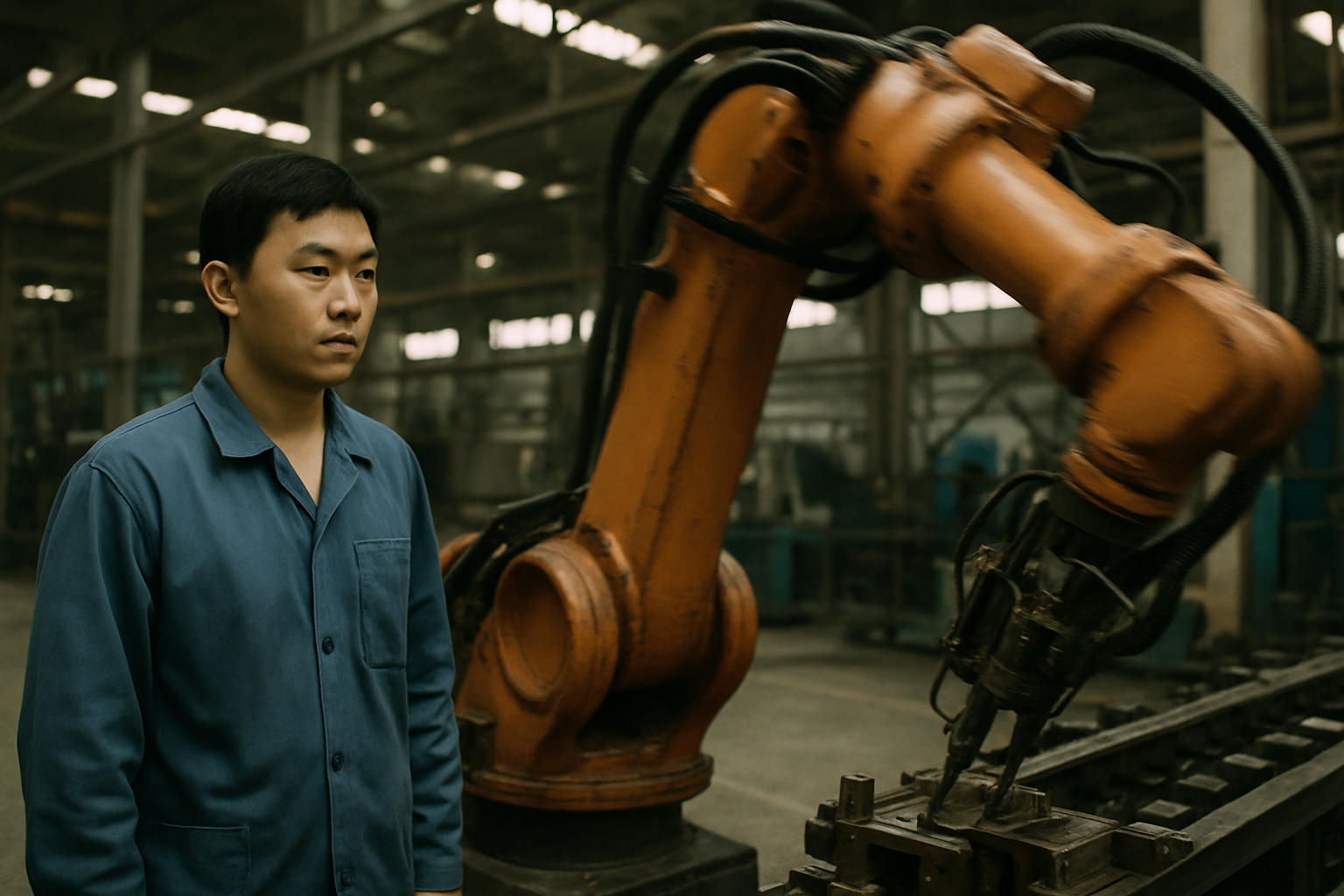
Something shifted in China's industrial economy last year that has barely registered in Western coverage of the AI race: for the first time, China became a net exporter of industrial robots. Exports rose 48.7 percent in 2025, and at this spring's Canton Fair in Guangzhou, the showrooms told the story visually. Machines were climbing walls, inspecting live power lines, chasing birds off airport runways. Buyers from Europe, Southeast Asia, the Middle East, and Latin America were placing orders.
The context matters. China already operates around 470 industrial robots per 10,000 workers, far above the global average of 162. It accounts for roughly 54 percent of global robot installations. The country did not just automate its own factories; it built the industrial base, refined the cost curve, and is now exporting the result. For many overseas buyers, Chinese automation offers something concrete: affordable solutions to labour shortages, safety risks, and rising wage pressure. The political label on the technology is increasingly a secondary consideration.
At the same time, a parallel story is playing out inside Chinese workplaces that is less comfortable to narrate from either a pro-growth or pro-technology angle. Reporting from MIT Technology Review, picked up by Futurism, describes a pattern emerging across Chinese offices: workers being instructed by managers to document their own workflows in detail, with the explicit goal of training AI agents to replace them. The open-source software at the centre of this trend is OpenClaw, which spread so quickly through Chinese enterprises this year that government agencies and state-owned enterprises issued warnings against installing it, citing security risks.
The human response has been striking. A GitHub project called Colleague Skill, built originally as dark satire, went viral on Chinese social media. It ingests a coworker's chat history and profile, then produces a detailed manual of how that person works, capturing their habits, quirks, and communication patterns. Workers began using it as a mirror held up to the trend. And then they started building tools to push back: one AI product manager created software that deliberately rewrites worker process documentation into vague, non-actionable language, specifically to frustrate the AI replacement pipeline. "I originally wanted to write an op-ed," he told MIT Tech Review, "but decided it would be more useful to make something that pushes back against it."
These two threads share a geography but not a perspective. At the Canton Fair, the pitch is efficiency and safety: robots doing the work humans should not have to do. In Chinese offices, the experience is different. Workers are not being offered liberation from dangerous jobs; they are being handed a documentation project whose purpose is to make themselves redundant. The fact that both processes are accelerating in the same country at the same moment is not a coincidence. It reflects the structural reality of where AI-driven automation is moving: outward into global export markets and inward into knowledge work simultaneously.
The World Economic Forum's Future of Jobs Report 2025 estimated that 41 percent of employers plan to reduce their workforce where AI can automate tasks. China is not unique in this dynamic, but it is further along the curve than most. What is happening there now is not a distant warning. It is a working model of how automation plays out when the industrial capacity, the software tooling, and the commercial pressure converge. The question worth watching is not whether Chinese robots will reach new markets. They already are. The question is what the labour adjustment looks like for the workers on the other side of that expansion.