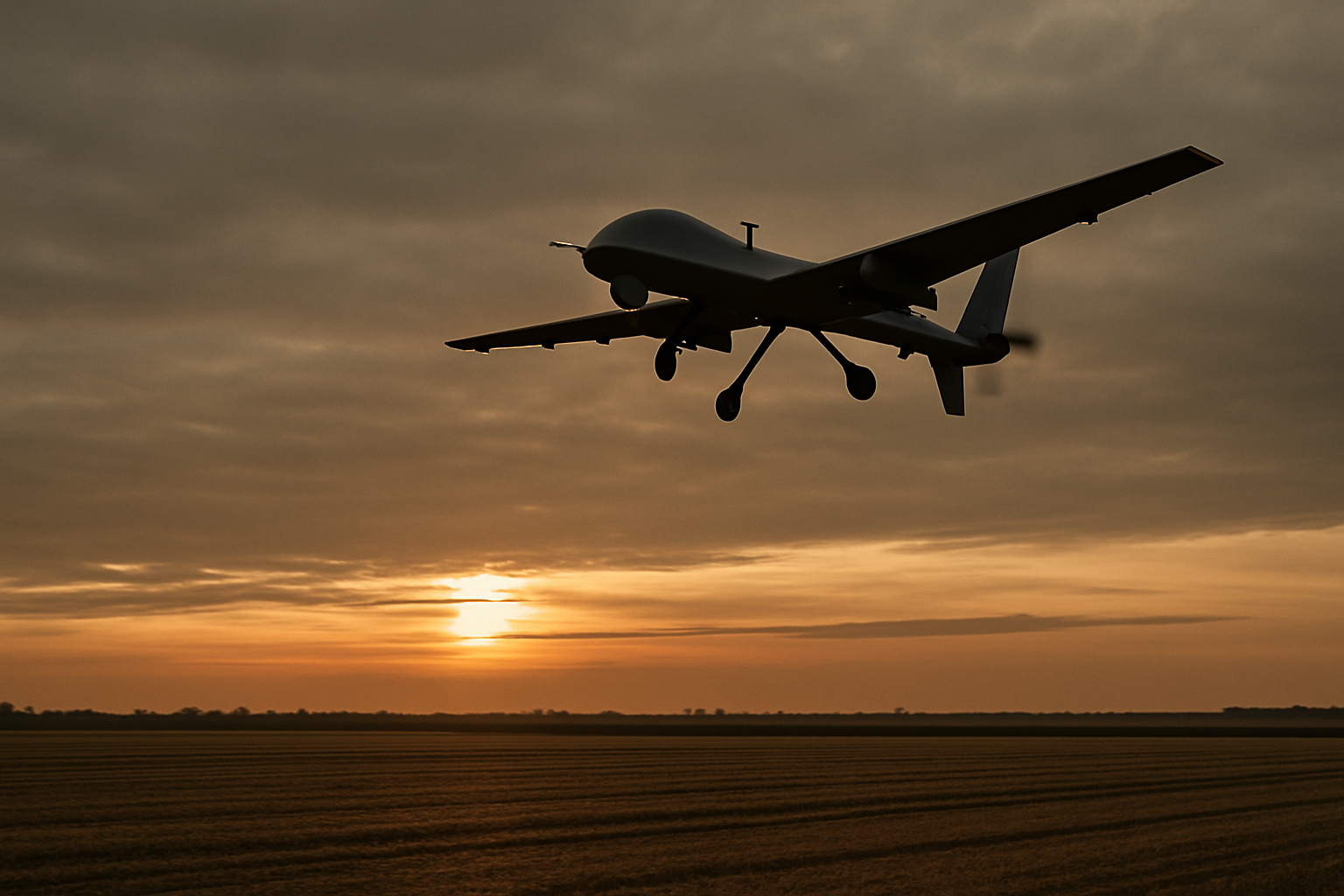
There is footage circulating of a Ukrainian fixed-wing drone flying 65 kilometres into Russian-controlled territory, identifying a fuel truck in a major occupied city, and completing a strike after its control link deteriorated and then broke entirely. The operator designated the target. A machine vision system locked on. When the signal dropped, the drone finished the job on its own. If that sounds like a significant threshold being crossed quietly, that is because it is.
The drone warfare story in Ukraine has been well covered at the tactical level: the cheap FPV drones, the 15-kilometre grey zones, the cat-and-mouse between jammers and pilots. What has received less attention is the shift happening at the operational level, where a new class of mid-range AI-enabled fixed-wing systems is extending Ukraine's reach deep into Russian rear areas. These are not the Shahed-style long-range munitions that Russia fires at Ukrainian cities. They are cheaper, more numerous, and built specifically to hunt the supply chain that keeps frontline Russian units fed and armed.
The strategic logic is not new, but the capability is. An army's logistics network resembles a tree: large depots feed distribution hubs which feed the individual positions. Destroying leaves, meaning frontline soldiers, is expensive and easily absorbed. The Russians replace casualties faster than they can be degraded. But destroying fuel trucks, water tankers, and ammunition carriers at the trunk level, deep behind the lines where jamming infrastructure is thin and dispersed, can starve those same positions without direct engagement. A soldier denied water resupply for seven days does not need to be shot.
The technical problem that made this approach impractical until recently was command and control over long distances. Jamming is effective close to the front. Fifty or seventy kilometres back, maintaining a reliable data link through varied terrain, buildings, and forests becomes extremely difficult. The solution Ukrainian engineers have arrived at is to hand the terminal phase to the drone itself. An operator designates the target. A machine vision algorithm locks on and maintains the solution. When the link fails, the onboard guidance system completes the final approach autonomously. The human is in the loop for targeting; the machine handles execution when the human can no longer see.
Bloomberg has tracked the broader arc of this evolution, noting that by early 2025 drones accounted for 60 to 70 percent of the damage inflicted on Russian equipment. Ukraine produced at least a million drones last year and is targeting two and a half million in production this year. The Washington Post has documented how the battlefield is changing faster than either side's doctrine can absorb, with new systems entering use before the tactical literature has caught up. Scientific American described drone-on-drone combat as marking a new era of aerial warfare, with dedicated anti-drone craft now using their own AI-guided intercept systems.
The commercial dimension of this battlefield is drawing significant investment. Bloomberg reported in March that Ukrainian battlefield technology firm UFORCE reached a billion-dollar valuation, a milestone that would have seemed implausible for a defence startup built on drone software three years ago. CNBC documented a broader pivot among Silicon Valley defence tech investors toward Ukraine-proven systems, arguing that the conflict has become the world's most demanding live testing environment for autonomous military hardware.
The implications extend well beyond the current conflict. Every military watching this war is learning that the economics of logistics interdiction have changed. A five-hundred dollar drone that destroys a forty-thousand dollar fuel truck, seventy kilometres behind the front, in a city that jamming cannot protect, is a different kind of weapon than anything that preceded it. The threshold it has crossed is not just technical. It is the moment autonomous terminal guidance stopped being a development project and became a deployed capability. That is harder to put back than a capability that was only ever theoretical.