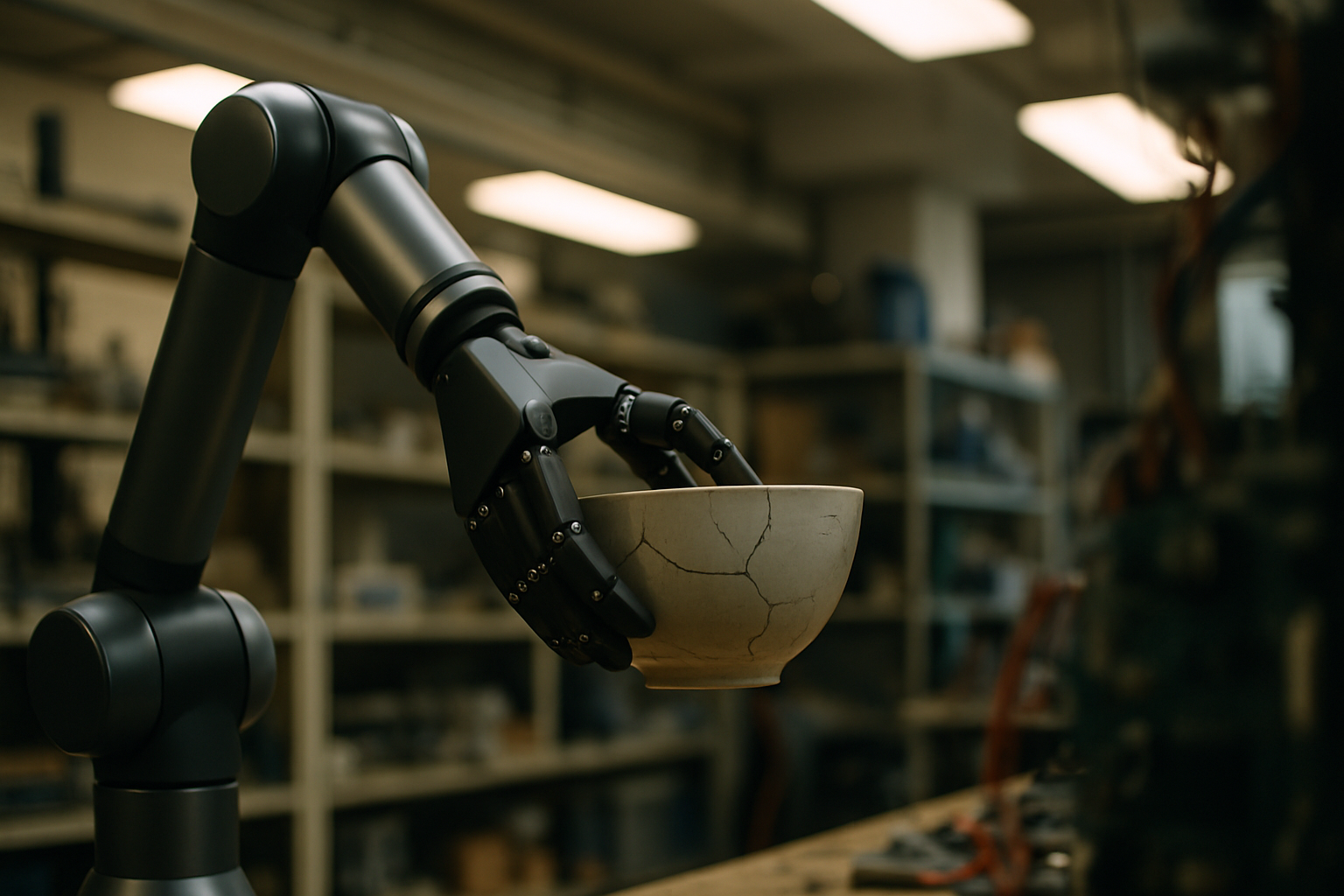
For most of the past decade, the gap between robots that could perceive their environment and robots that could reason about it sat like a moat around real-world usefulness. Robots were fast and consistent in controlled settings but brittle the moment something unexpected happened. Google DeepMind's Gemini Robotics 1.5, released this week, is a direct attempt to fill that moat. The model is billed as the company's most capable vision-language-action system to date, and its central claim is simple: before a robot moves, it now thinks out loud about why.
The system actually comprises two complementary models working in tandem. Gemini Robotics-ER 1.5 handles the reasoning side: it takes in visual information and natural language instructions, builds a multi-step plan, and breaks the task into discrete sub-goals. Those sub-goals are then passed to Gemini Robotics 1.5, the action model, which translates each step into precise motor commands. The loop between them is what DeepMind calls an "agentic framework," and the language is deliberate. This is not a single model mapping pixels to movement. It is a system where one component thinks and another acts.
The visible thinking is the most immediately striking feature. Gemini Robotics 1.5 can narrate its decision-making in natural language as it works, explaining why it is choosing a particular grip angle or why it is pausing before proceeding. For engineers working with the system, this transparency is valuable beyond safety optics: if a robot fails a task, the logged reasoning chain tells you where the logic broke down. DeepMind reports that Gemini Robotics-ER 1.5 now achieves state-of-the-art performance on spatial understanding benchmarks, a category that has historically been a hard limit for language models whose training data is overwhelmingly flat text rather than three-dimensional experience.
The commercial rollout is cautious by design. Gemini Robotics-ER 1.5 is available to developers through the Gemini API in Google AI Studio now. The action model, Gemini Robotics 1.5, is currently offered only to select partners. DeepMind's reasoning is presumably that mistakes by a system capable of affecting the physical world carry consequences that mistakes by a chatbot do not, and a staged deployment allows early partners to surface failure modes before the audience widens.
What makes this announcement worth paying attention to is not just the capability jump, though that is real. It is the framing. DeepMind is describing its robots not as automated tools but as agents that reason. The language comes loaded with implications. An agent that explains its thinking creates an expectation of accountability. When the reasoning is visible and the action is still wrong, someone has to answer for that. The question of who owns a robot's mistake when the robot can tell you what it was thinking is not a hypothetical any more.
There is also a tension in the "think before acting" pitch that deserves a harder look. The reasoning narration is generated by a language model. Language models are fluent, confident, and occasionally wrong in ways that are very difficult to detect from the text alone. A robot that articulates a plausible-sounding plan before doing the wrong thing is arguably more dangerous than one that just fails silently, because the narration creates an impression of deliberation that may not correspond to actual reliability. The benchmark results are promising, but benchmarks have a long history of not surviving contact with real warehouse floors, hospital wards, or construction sites.
The broader arc is clear enough: the coupling of large-scale reasoning models to physical actuators is no longer a research curiosity. Google, NVIDIA, and a half-dozen robotics startups are all converging on the same architecture from different directions. The physical world is becoming the next frontier for AI deployment, and the timelines are compressing faster than most predictions from two years ago would have suggested.