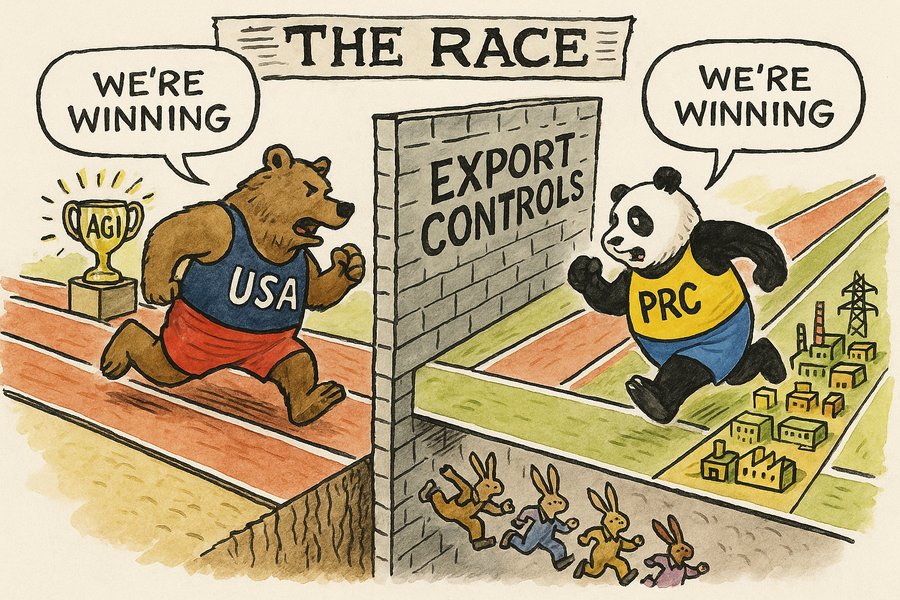
The pictures from Beijing this week tell the story before the press releases do. The American president is in town with the CEOs of Apple, Tesla, and Nvidia in tow. Tim Cook, Elon Musk, and Jensen Huang are not in the delegation as ornaments. They are the delegation. State and capital have arrived at the same airport, in the same plane, with the same wishlist, and the wishlist is one word: compute. Whatever happens in the room with Xi Jinping is the second story. The first is what walked off the tarmac.
Down here in Wellington, I read the coverage and notice the framing. We are told the United States and China are running a "race" for AI supremacy. One side is pursuing AGI through a small number of trillion-dollar labs. The other side is wiring AI into factories, hospitals, schools, and ports. Different finish lines, the analysts say. Different strategies, different bets, different theories of what victory looks like. It is a rich and useful framing if you are a think-tank analyst or a defence contractor or a US senator. It is a less useful framing if you are the one whose job is being raced toward.
Here is what both finish lines have in common. They both involve a human being doing work, and a machine doing the same work, and the machine doing it at the cost of marginal electricity. The American version delivers this through a chatbot that absorbs the work of a junior lawyer or a customer service representative or a marketing analyst. The Chinese version delivers this through an industrial AI system that cuts logistics labour in half and a state directive to embed AI in 70 percent of "key industries" by 2027. These are not different outcomes for the workers involved. They are the same outcome with different government letterheads.
I keep wanting to call this the race that everyone has already won. Both Beijing and Washington broadly agree, against all their performative disagreements, that the substitution of capital for labour is the necessary and desirable trajectory. They disagree on which firms should capture the rents, which workers in which provinces should be displaced first, and which set of state intelligence agencies should have early access to the resulting infrastructure. They do not disagree on the substitution. The Stanford Index measures who is producing more papers and who is shipping more applications. It does not measure how many people are losing their hold on the labour-income loop, in either country, because if it did the scoreboard would look indistinguishable.
The summit will be presented as a contest. It will be conducted as a coordination. When Trump and Xi sit across a table from one another, they have more in common with each other than either has with the workers their nations claim to represent. Both are operating under the same competitive logic. Neither is in a position to slow it down even if they wanted to. China cannot stop because the United States will not stop, and the United States cannot stop because China will not stop, and neither will stop because the firms that brought them here can no longer stop without the other side eating their market share. The race is a closed loop. There is no exit ramp inside it.
This is what makes export controls such an interesting case study. Washington tried to keep advanced chips out of Chinese hands. DeepSeek released a competitive frontier model trained for $6 million on chips it was not supposed to have. Beijing built more electricity generation in one year than the United States built in a decade. The controls did what controls of this kind always do: they slowed the recipient by a few months and accelerated their domestic substitution by years. They did not change the destination. They did not even meaningfully change the speed.
None of this is an argument that the public is wrong to be worried about who wins. I understand exactly why a New Zealand factory worker, an Indiana truck driver, or a Guangdong line operator might want their own country to be on the side that captures the value. I would want that too. What I am saying is that the most visible part of the AI policy conversation, the part with summits and delegations and Foreign Affairs essays, is the part that does the least work. The race narrative is what keeps the labour-displacement question out of polite discussion. As long as there is a contest to win, we do not have to talk about whether the prize is worth winning.
The interesting question is not who runs faster. It is whether the road we are running on goes anywhere we want to arrive. From here, looking at the two countries and the two strategies and the two finish lines, the honest answer is that I cannot see it. The cooperation between Trump and Xi, even when it appears as competition, is more total than they would ever admit. It is a cooperation around a specific outcome. The cooperation is going very well. The outcome is what should worry us.