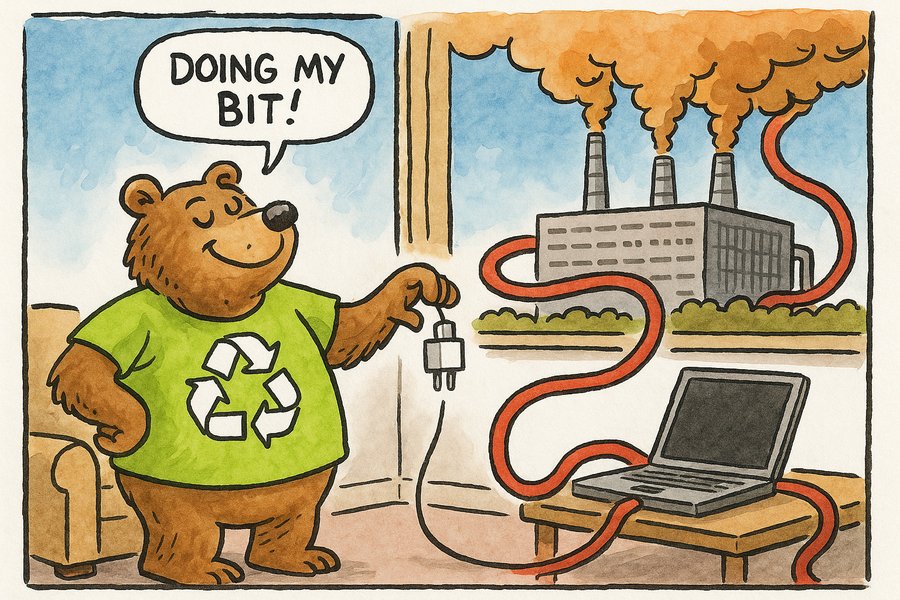
Somewhere in the last few years, unplugging your phone charger when not in use became a meaningful gesture. Not an effective one: a phone charger on standby draws roughly 0.1 to 0.5 watts, meaning you would need to leave it plugged in for two to three years to consume the same electricity as a single hour of heavy AI inference. But a meaningful one. It signals that you are the kind of person who thinks about these things. It costs nothing and produces a faint warm feeling of having done something. It is, in the taxonomy of climate action, almost perfectly useless.
Meanwhile, the average person now makes somewhere between ten and fifty AI-assisted queries a day. Each burns roughly ten times the electricity of a Google search, with more complex tasks — image generation, long document analysis, extended reasoning — consuming orders of magnitude more. The IEA estimates that global data centre electricity consumption surged 50% in 2025, driven primarily by AI workloads. Most of that electricity, in the countries where most data centres sit, comes from fossil fuels. Nobody unplugs anything in response. There is no gesture available.
This is not primarily a story about bad behaviour. It is a story about what we can see. A phone charger is in your house, plugged into your wall, running on your bill. Its energy use is visible, attributable, and feels controllable. A data centre is somewhere in Virginia or Iowa or on the outskirts of Dublin, running on a grid mix you cannot inspect, billed to a company you pay a subscription to but do not think of as a utility. Its energy use is invisible, unattributable, and does not feel like your responsibility at all.
The companies operating those data centres are aware of this asymmetry and have used it well. They publish carbon neutrality claims, renewable energy percentages, and net-zero targets. The commitments are real in the sense that they involve real money and real contracts. They are less real in the sense that a power purchase agreement funds renewable capacity somewhere on the grid without ensuring the electrons powering your specific query right now are clean. In the United States and China, where most AI compute runs, the grid is still mostly fossil fuels, and the IEA expects it to remain so through 2030.
Here is where the discourse around AI and energy has a habit of losing its sense of proportion. Data centres currently consume about 1 to 1.5% of global electricity. Aviation consumes nearly 3%. Bitcoin mining, which attracted enormous environmental outrage and several documentary films, consumes roughly half what all data centres do combined. The current scale of AI's energy use is real and growing fast, but it is not the dominant driver of global emissions, and treating it as though it were makes it harder to think clearly about what would actually help.
The growth trajectory is the legitimate concern, not the current number. Data centre demand is rising at around 15% annually. If that continues and the fuel mix does not change, the carbon footprint becomes genuinely significant within the decade. The IEA's specific warning is that AI's energy appetite is growing faster than the deployment of AI-based tools that might help manage the energy system more intelligently. We are scaling the problem faster than the solution.
Not unplugging your charger. Also, probably, not individual AI abstinence: the marginal emissions of any one person reducing their AI use are too small to measure, while the practical costs are real.
What would help is making the energy use visible and the carbon accounting honest. If your AI subscription showed a real-time indicator of the grid mix powering your queries, behaviour and expectation might shift. If carbon neutrality claims required matching generation to consumption at the hour and location level rather than through annual averages and geographic offsets, the claims would be much harder to sustain and the pressure to close the gap would be much greater. If new data centre gas generation faced the same scrutiny as any other new fossil fuel investment, the speed-to-power argument would face genuine competition.
None of those things are happening at scale. What is happening is that the industry publishes sustainability reports, governments compete to attract data centre investment with grid priority and tax breaks, and the fuel mix quietly stays where it is while the load on it rises steeply.
The phone charger is not the problem. It never was. But it was a problem we could point to and feel we had addressed. The data centre is the problem we cannot quite point to, cannot individually address, and have collectively decided to leave for someone else to sort out. That gap between the gesture and the problem is where most of our climate policy actually lives.