Last week, a senior economist at Apollo published a blog post comparing the current AI disruption to the "China shock" of the early 2000s. His conclusion was reassuring: it will work out. China's WTO entry cost four million US manufacturing jobs over two decades, but the macro economy adapted. Productivity rose. New industries emerged. The bottom line, he wrote, is that "we have seen this before." History as comfort. You almost want to believe it.
Almost.
Here is what the China shock actually showed, if you look at it without optimism as a lens. The four million manufacturing jobs that disappeared were concentrated in specific communities: Youngstown, Ohio. Gary, Indiana. Flint, Michigan. Textile towns in the Carolinas. These were not abstract data points. They were places where people had built lives, bought houses, raised children, on the assumption that the work would continue to be there. The assumption turned out to be wrong. The economists who wrote the original China shock papers documented the damage: persistent wage depression, elevated mortality, communities that never fully recovered. The macro numbers eventually worked out. The macro does not live in Youngstown.
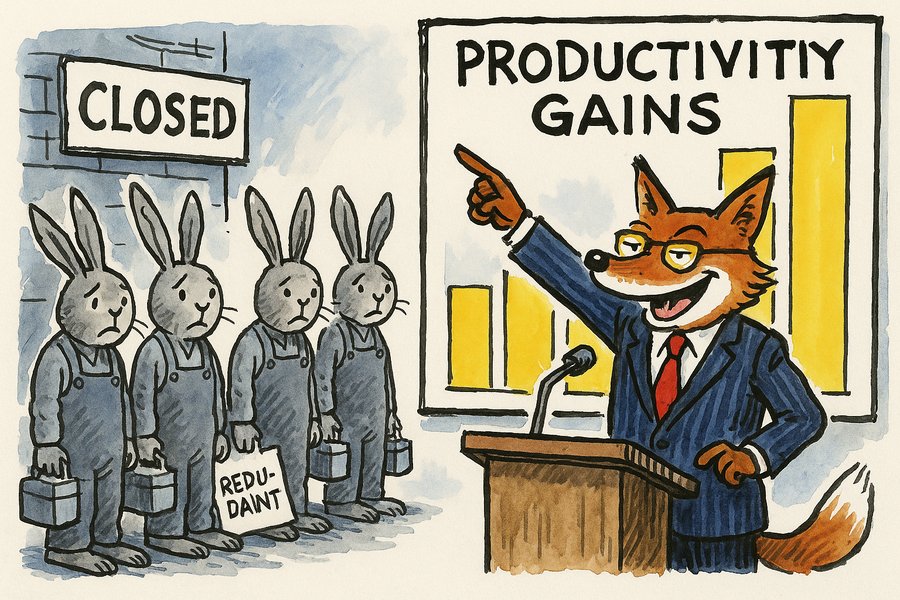
Now look at how the reassurance is being deployed. The China shock is offered as evidence that AI displacement will also resolve in aggregate. What the reassurers tend not to linger on is the cost the China shock imposed and who paid it. If your argument is that the AI shock will follow the same playbook, you have to accept that the same playbook included four million people losing livelihoods, decades of uneven adjustment, and productivity gains captured overwhelmingly by shareholders and firms rather than by the workers whose roles had been displaced. That is the playbook. All of it.
This week, MinterEllison, one of Australia's largest law firms, announced it was cutting its graduate intake by nearly a third. Unlike its competitors, who are attributing similar cuts to seasonal variations and shifting market conditions, MinterEllison said the quiet part out loud: the routine work graduates used to do is now being done by AI. Document review, basic research, discovery. The entry-level roles are being structured out of existence.
The China shock comparison does not map cleanly onto this. The China shock was geographically concentrated; policy responses, however inadequate, could at least be targeted at affected regions. The AI disruption is functional, not geographic. It removes specific kinds of work from every sector and every region simultaneously. A legal graduate in Sydney and a paralegal in Auckland and a junior analyst in London are all looking at the same structural problem: the entry-level tasks that were supposed to be the training ground for higher-skilled work have been automated before they got there. You cannot retrain into something when the destination keeps moving.
And there is a second asymmetry that the China shock comparison papers over. When cheap Chinese manufactured goods flooded into the US economy, they at least reduced costs for US manufacturers and consumers. The productivity gain was real and had some distributional spread, however unequal. When AI replaces a paralegal, the firm saves the cost of that role and captures the saving as margin. The displaced paralegal earns nothing and buys less. Multiply this across a large enough share of the workforce and you are not just redistributing income. You are beginning to shrink the total pool of income available to circulate. The economy runs on a loop: companies employ people, people earn wages, people spend wages, companies have customers. Break enough of the loop and the whole system starts to degrade. This is not a metaphor for a possible future. It is an arithmetic description of what happens when the human in the income cycle is replaced by a machine that earns nothing and spends nothing.
I am not saying the economists are lying. The productivity gains are real. New industries do emerge. Aggregate employment has proved more resilient than doomsayers predicted in every previous technological disruption. These are honest observations. What is missing from the reassurance is an honest account of who bears the cost during the disruption, how long that disruption lasts, and whether the gains that eventually arrive are distributed in a way that reaches the people who paid for them.
The China shock is history that the people who lived through it would not describe as a success story. Using it as comfort requires a view from a considerable altitude. Down on the ground, the view is different.