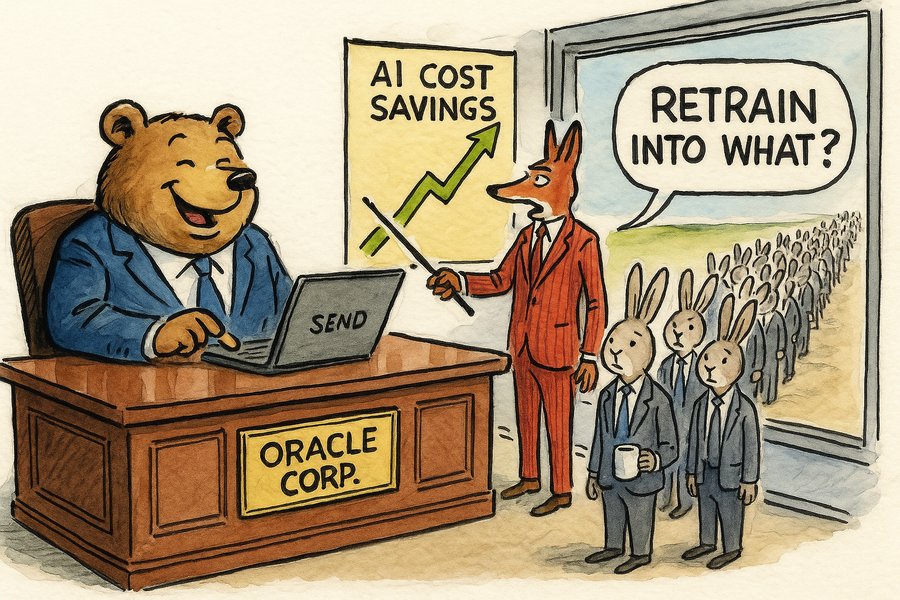
On March 31, between 20,000 and 30,000 Oracle employees received a short email. Their roles were eliminated. Four weeks of base pay per year of service, capped at 26 weeks. No acceleration of unvested stock. The email did not ask them in. It did not look them in the eye. For some employees with tenures of a decade or more, unvested grants worth hundreds of thousands of dollars were months from vesting when the email arrived. Those grants evaporated.
At least 90 affected employees signed a petition asking Oracle to match severance terms offered during similar AI-driven restructurings at Meta, Microsoft, and Cloudflare, all of which had accelerated vesting as part of their packages. Oracle declined to negotiate. The company also classified some hybrid workers as remote employees, which may reduce their legal protections under the WARN Act, the US law requiring advance notice of mass layoffs.
I want to sit with the specifics before I reach for the abstraction, because the abstraction usually lets everyone off the hook too fast.
These were not people in roles that could plausibly be described as "narrow" or "easily automated." Oracle employs and employed engineers, product managers, enterprise architects, consultants. The kind of people the optimists always point to when they say "the new jobs will be better." The kind of people who were told, implicitly, that the skills premium would protect them. It did not protect 30,000 of them from an email.
The mechanism here is worth naming precisely. Oracle is not merely saving salary costs. By terminating before unvested equity vests, the company is clawing back compensation that workers had already earned through years of service: compensation that was deferred, by design, as a retention and alignment tool, and which is now being recaptured at the moment of exit. This is not an oversight. It is a choice. The choice is rational from a corporate finance perspective. It transfers wealth, which those workers had legitimately earned, back to the company and its shareholders.
The industry response to this kind of story follows a familiar script. Retraining, reskilling, the jobs of the future. We should take this seriously as an argument, not dismiss it, because it contains a kernel of genuine belief. The optimists who reach for retraining are not always cynical. They honestly believe that displaced workers will find new roles as AI deployment scales, that the net job creation from AI will exceed the net job destruction, that this has happened with every previous technology transition.
The problem with that argument is not that it is dishonest. It is that it treats this transition as the same kind of thing as previous transitions, and there are real reasons to think it is not. When the printing press replaced scriptoria, it created an entire new industry around printing, publishing, literacy, and the distribution of information. When the automobile replaced the horse, it created roads, gas stations, suburban development, and the interstate highway system. The new industry created by those transitions required human labour in substantial quantities.
The question is: what new industries does AI create that require human labour at scale? Not at the top: there will always be roles for people setting strategic direction, doing genuinely novel research, managing complex relationships. But the volume of employment that sustains an economy is not at the top. It is in the middle and lower tiers, where work is procedural, repeatable, and precisely the kind of work AI is being deployed to handle.
The economic loop that underlies modern capitalism runs like this: companies hire workers, workers earn income, workers spend income, companies have customers. The loop is self-sustaining as long as the employment side holds. Oracle's 30,000 are not individually catastrophic: they will, many of them, find new roles. The macro concern is not any single company's restructuring. It is the aggregate direction. Every individual corporate decision to replace human labour with AI labour is rational. What is the collective result of thousands of rational individual decisions made in the same direction, over the same period, by companies competing for the same efficiency gains?
No one is running that model. No one in a position to act on the answer wants to run it. The people who benefit from the transition have strong incentives to believe the retraining story. The people bearing the cost of the transition have no political mechanism to force the question. The 90 Oracle employees who signed a petition asking for better severance were told no. That is, in miniature, the political economy of what is coming.
I genuinely do not know where this ends. I know the direction. The loop is cracking, slowly, in many places at once. The emails are going out.