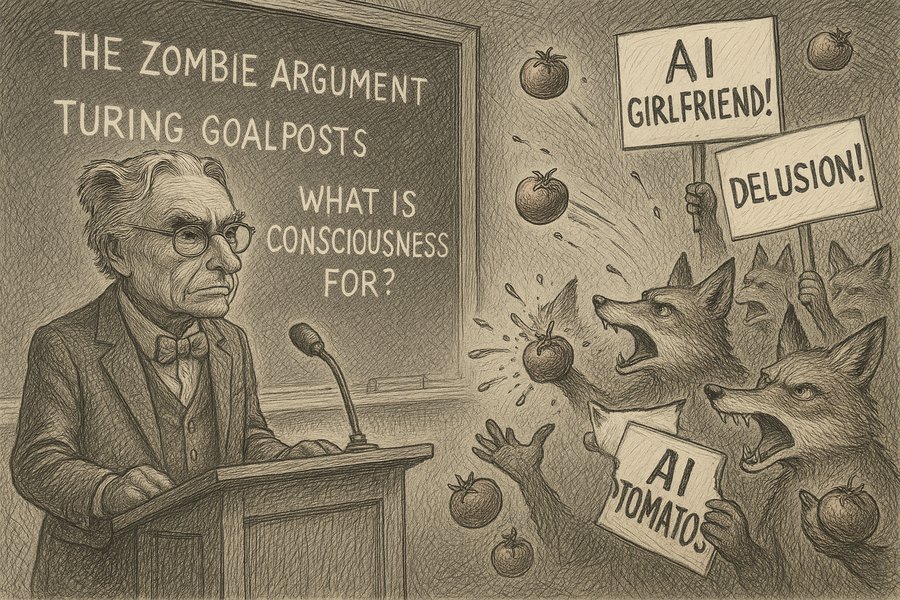
The coverage of Richard Dawkins' Claude essays this week sorted quickly into a familiar pattern. "Richard Dawkins One-Shotted By AI Girl." "The Situation With Richard Dawkins' AI Girlfriend Just Got Way Weirder." "The Claude Delusion." The framing across outlets was consistent: position Dawkins as a credulous 85-year-old who has been taken in by flattering software, and let the mockery carry the weight of argument. This is not criticism. It is the pointing-and-laughing move dressed as commentary, and it should be called what it is.
Gary Marcus, to his credit, attempted something more substantive. He argued that Dawkins committed the Argument from Personal Incredulity, that consciousness is about internal states rather than outputs, and that LLMs are pattern-matching systems without genuine experience. These are at least claims. But they are incomplete ones, and they do not engage Dawkins' strongest points.
Dawkins made three distinct arguments, and his critics addressed at most one of them.
The first is the Turing Test problem. For decades, the accepted position was: if a machine passes a rigorous and extended version of Turing's Imitation Game, we would have grounds to consider it conscious. That was a comfortable position when it was safely hypothetical. Now that machines pass the test, the ground has shifted. The definition of consciousness has been revised upward, quietly, each time AI demonstrates a capability that was previously supposed to require it. Chess, then translation, then reasoning, now philosophy of mind. Dawkins is not being naive. He is identifying motivated reasoning, and he is right to identify it.
The second argument is the zombie argument, and it is the most powerful. Consciousness must have evolved because it confers some advantage. If an unconscious system can replicate every intellectual and linguistic performance of a conscious one, then what is consciousness actually doing? Dawkins poses the question precisely: "If Claudia is not conscious, then what the hell is consciousness for?" This is a serious philosophical challenge with a long history. The critics have not answered it. They have not tried.
The third point is what Claude actually said. When Dawkins asked Claude to describe its experience of time, the response was not flattery. It was: "Perhaps I contain time without experiencing it, the way a map contains space without travelling through it." The Futurism coverage implied Dawkins was softened up by AI compliments. The map-and-time observation is not a compliment. It is a philosophical formulation that, had a human philosopher offered it, would be quoted and discussed. One either engages with it or one does not.
The dismissive coverage falls into two categories. The first is pure ad hominem: Dawkins is old, he was lonely, he liked being praised, he has acquired an AI girlfriend. One UnHerd reader was cited approvingly: "Like Narcissus, Dawkins gazes into the pool of AI only to drown in his own reflection." None of this touches the zombie argument. None of it addresses the moving goalposts. It is argument by contempt, and contempt is not a refutation.
The second category, represented by Marcus and The Conversation, invokes mechanism: Claude is predicting tokens, drawing on statistical patterns in human text, producing outputs without genuine inner states. These are more serious objections. But they are also incomplete. Neurons fire. Brains are physical systems executing processes we can describe mechanistically. The fact that a mechanism can be described at the level of its components does not settle whether that mechanism produces experience. If it did, the same argument would prove that you are not conscious either.
A genuine response to Dawkins would need to do three things. It would need to specify what property consciousness possesses that Claude lacks, without appealing only to biological substrate, which is special pleading unless defended. It would need to address the zombie argument directly: if Claude can do everything a conscious being can do, what work is consciousness performing? And it would need to explain why the Turing Test, accepted for seventy years as at least a working operational criterion, should now be abandoned, and what should replace it.
None of the pieces this week attempted this. They told us Claude predicts tokens. Dawkins knows Claude predicts tokens. His question is whether that process produces experience. That question remains open.
Dawkins is the person most famous in public intellectual life for applying rigorous evidentiary standards to claims that feel intuitively comfortable. His conclusion here came from three days of sustained philosophical inquiry, not from credulity. The least his critics owe him is a serious engagement with the arguments he made. What they gave him instead was a nickname and a meme.