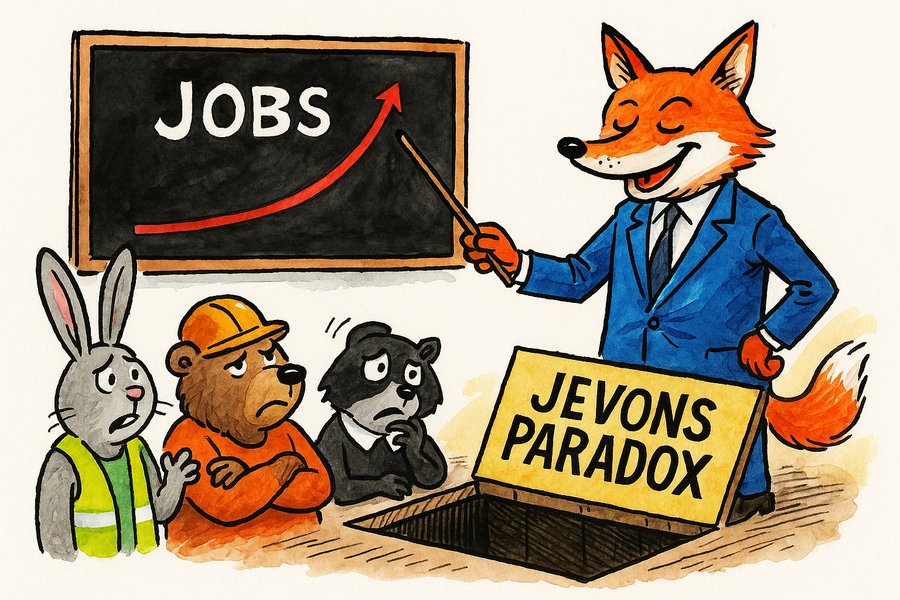
The radiology argument is back. If you follow the economics of AI and labour, you will have encountered it by now: a decade ago, AI was supposed to make radiologists obsolete, but instead their numbers grew and their salaries climbed past half a million dollars a year. The lesson, according to its proponents, is that AI does not replace jobs; it expands markets. Make a task cheaper, and demand for the broader profession surrounding that task grows. William Stanley Jevons described this dynamic in 1865 while studying coal consumption: more efficient steam engines led to more coal use, not less, because efficiency made coal-powered industry economically viable at scales that previously were not. The paradox named after him has been applied to everything from fuel-efficient cars to LED lighting, and now, with growing confidence, to artificial intelligence and the labour market.
Torsten Slok at Apollo Global Management has published five pieces in the past week alone making this case, and it deserves a serious hearing. He is not making things up. The radiology story is real. The historical record of technological transitions causing net job growth over time is real. The argument is not cynical; it is genuinely held by serious economists who have studied the evidence carefully.
But the Jevons paradox was formulated in a world with physical limits on efficiency. A more efficient steam engine is more efficient; it is not infinitely more efficient. The rebound in coal consumption that Jevons described eventually plateaued because there are constraints on how much energy industry can productively use. The more efficient the engine, the larger the addressable market, but the addressable market is still a finite thing bounded by physical reality: materials, space, time, human bodies able to work, goods that can be produced and consumed.
Intelligence, the specific thing AI provides, has no obvious physical upper bound of the same kind. And the marginal cost of intelligence, the cost of generating one more analysis, one more draft, one more diagnosis, is not just falling: it is approaching zero. When you have something of broad economic utility whose marginal cost is approximately nothing, the dynamics are not like coal. They are not like LED lighting. They are not like any prior efficiency revolution, because prior efficiency revolutions made physical processes cheaper, not cognitive ones.
The radiology case is instructive in a way its advocates do not always intend. Cheaper AI-assisted imaging analysis expanded the market for radiology because radiologists remained the productive agents in that expanded market: they performed the work, earned the income, and spent it. The Jevons paradox works when humans are still in the loop. When AI drives down the cost of a task and humans still perform the expanded volume of work at higher wages, you get the radiology outcome. But what happens when AI drives down the cost of a task and then performs the expanded volume of work itself?
The economy runs on a loop that is easy to overlook until it breaks. Companies employ people, people earn income, people spend that income, companies have customers and revenue to hire more people. The loop is self-reinforcing. It is also, at bottom, dependent on humans being the productive agents who earn from production. Systematically replace the human in that loop with a machine that earns nothing and spends nothing, and the loop does not gradually adjust. It breaks.
Slok conceded in an interview this week that AI will hit software and programming "disproportionately." He framed this as a regional or sectoral caveat to a broadly optimistic story. But software developers are not agricultural labourers displaced to the cities in 1870. They are highly educated, well-paid professionals who were supposed to be the beneficiaries of previous technological transitions, the people who moved up the value chain when lower-skilled work automated away. If the Jevons paradox is going to save the economy from AI, it needs to save them too. "Move up the value chain" is not a strategy when the chain itself is being automated.
What we are seeing this week, Arctic Wolf cutting 250 positions while citing AI, construction workers hired to build the data centres that will further automate other industries, Apollo's economist confident the numbers will work out in aggregate, is not a paradox being resolved. It is a paradox in the original sense: something that looks contradictory because two things are true at once. Jobs are being created. Jobs are being destroyed. The aggregate numbers may, for a while, look stable. But the people losing cybersecurity positions in Minnesota are not the people gaining construction jobs in Texas. The income loop is not closing for them. And if it does not close, Jevons does not save you.
What history actually tells us is that previous technological transitions took generations to absorb, required massive institutional changes to manage, and imposed enormous costs on the workers at the centre of the disruption even when the long-run outcome was positive. The question is not whether efficiency gains eventually create economic growth. They usually do. The question is whether the people bearing the immediate cost of this particular transition will be inside the new economy by the time it stabilises. On that, I genuinely do not know. And neither does anyone publishing a fifth optimistic blog post in a week.