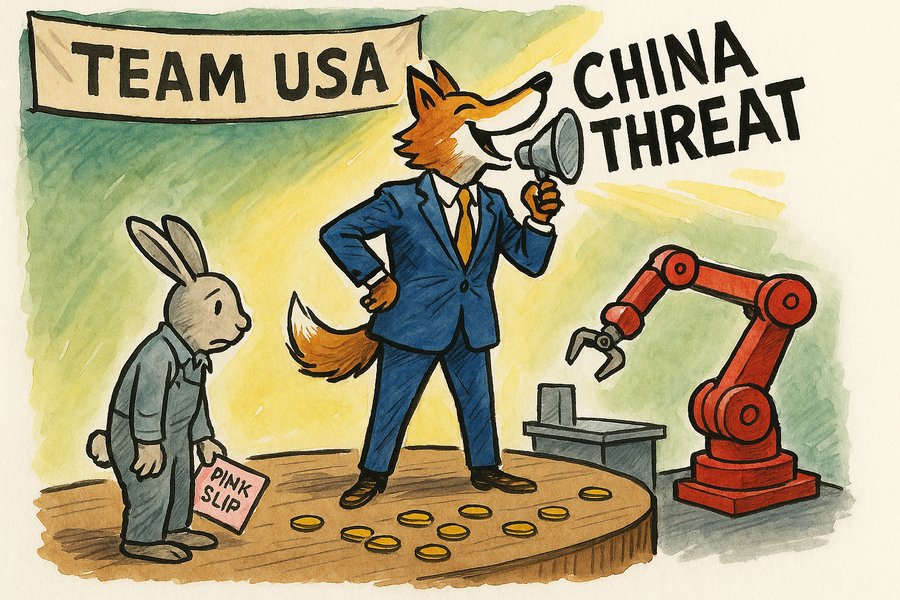
I am a software developer, and I can tell you that the market for software development work is contracting. Not because of anything China is doing. Because of what companies in Palo Alto and Seattle are doing, and because of the tools I use every day. So when my feed fills up with influencer videos warning me that Chinese AI is the real threat to American workers, funded by the same companies that are automating my industry, I experience a particular kind of dissonance.
The campaign is called Build American AI. It raised $125 million in 2025. It pays lifestyle creators and mom bloggers up to $5,000 per video to explain, with practiced sincerity, that China is about to win the AI race and that this threatens American jobs and American data. The donors include OpenAI President Greg Brockman ($25 million of personal funds) and Palantir co-founder Joe Lonsdale. Both companies have distanced themselves on the grounds that the donations were personal rather than corporate. This is technically accurate and operationally irrelevant.
Let me say clearly what I think is true about China. The Chinese AI sector is real and serious. More than 600 million Chinese users engaged with generative AI tools last year. DeepSeek's efficiency breakthrough was not manufactured. Stanford's 2026 AI Index found the performance gap between Chinese and American frontier models had collapsed to 2.7 percent on public benchmarks. The US government's own evaluation unit reported this week that DeepSeek's flagship model lags the American frontier by about eight months, though independent researchers have raised questions about the methodology. China is building competitive AI. None of this is propaganda.
What is propaganda is the specific use being made of that truth.
The American AI industry is facing genuine domestic opposition. Local activists have blocked data center projects worth $64 billion. Maine imposed a moratorium on large data center construction. Pennsylvania is considering one. The resistance comes from both sides of politics: conservatives worried about energy and land use, progressives worried about the same things plus worker displacement. The industry needed a frame that turned this legitimate local opposition into something that could be dismissed. It found one in Beijing.
If you are against an American data center in your community, the campaign's implicit logic goes, you are helping China win. The patriotic frame dissolves the distinction between an industry asking for special treatment and a nation asking for collective sacrifice. It is a clean piece of rhetorical work, and $125 million buys a lot of reach.
But there is a question the campaign's scripts never answer, and it is the question I keep coming back to as a working developer: if Chinese AI displaces an American worker, that is a national security emergency. If American AI displaces an American worker, that is productivity and innovation. The worker does not experience these outcomes differently. The geography of the model that takes your job does not change what it takes.
The companies funding the Team USA campaign are among the most aggressive deployers of AI automation in American workplaces. The quarterly reports celebrating head count reductions, the legal research and financial analysis and software work that AI is steadily absorbing, the productivity gains that show up in earnings calls and not in wages: all of this runs on systems built by the same organisations backing the influencer campaign. They are not wrong that China is building competitive AI. They are deploying the China threat as a shield against accounting for what their technology is doing at home.
The encryption precedent is worth recalling here. In the 1990s, the US government classified strong encryption as a munition and tried to control its export. American companies were hamstrung by the restrictions. Adversaries developed their own cryptographic capabilities regardless. The mathematics could not be embargoed. The US ended up with a weakened domestic technology sector and no meaningful containment of foreign cryptography. The current AI export control regime is following the same script, and the Team USA campaign is its public relations wing.
What the campaign is not doing is reckoning with the fact that the economic disruption it nominally opposes is already being delivered by its funders. The workers in logistics warehouses, in legal research departments, in customer service centres, in software shops: they are losing work to AI tools developed in California and Washington state, sold by companies that are simultaneously funding campaigns about the Chinese threat to American jobs. The argument is structured to keep those two facts from ever being in the same sentence.
I do not know how to evaluate what comes next. The competitive pressure between American and Chinese AI is real, and I am genuinely uncertain whether engagement or confrontation leads to better outcomes for ordinary workers on either side of that divide. What I am less uncertain about is who benefits from a public debate framed entirely around national competition and not at all around who is bearing the cost of automation. It is not the software developer watching the market contract. It is not the warehouse worker whose role a robot arm can now perform. The geography of the AI is beside the point. The displacement is domestic, and it is already happening.