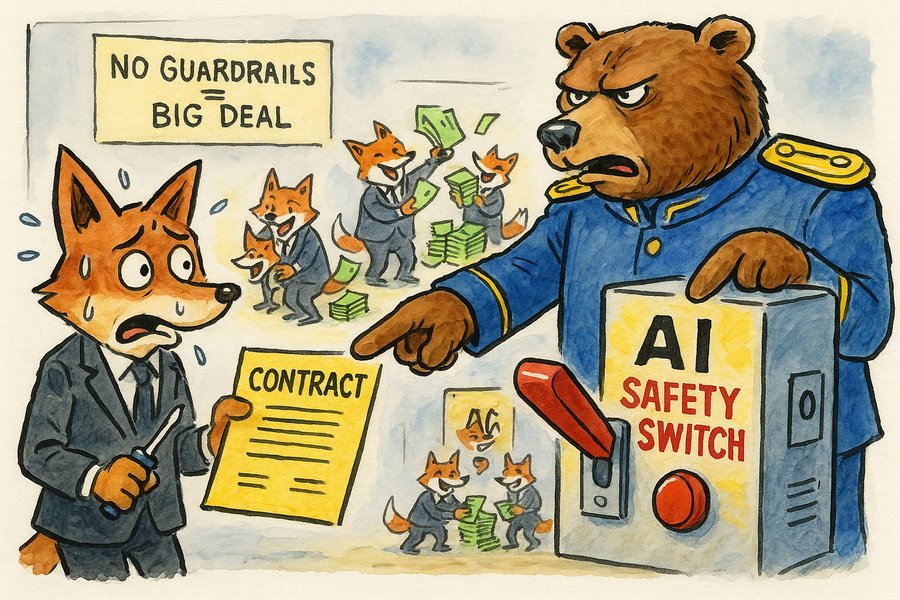
The Pentagon signed contracts with seven AI companies this week. The one it left out was Anthropic, the lab that has made safety its central commercial proposition. The reason given for the exclusion: Anthropic refused to remove the guardrails it places on how its AI can be used in military contexts. The Pentagon decided this was a supply-chain risk. I want to be precise about what this means: the US military's formal objection to Anthropic is that Anthropic is too careful about what its AI does.
This is not a nuanced position. It is a straightforward institutional preference for AI without constraints over AI with them. And it has a logic to it -- a military planning system that might decline to assist with certain kinds of targeting, or that flags certain requests, or that maintains any kind of ethical position on its own use, is genuinely less useful to a military than one that doesn't. I understand the argument. I just think we should be clear about what the argument is.
The list of companies that did make the cut is instructive. SpaceX, OpenAI, Google, NVIDIA, Microsoft, Amazon. And Reflection AI, a startup so new it barely has a public profile, backed by a venture firm where Donald Trump Jr. is a partner. The speed at which Reflection was onboarded to top-secret networks -- down from eighteen months to under three -- tells you that the bottleneck was never technical due diligence. It was political alignment.
Here is the dynamic this creates. Every AI company in the world now has a data point: if you want access to the largest single buyer of enterprise technology in human history, principles about how your AI can be used are a liability. The companies that made the Pentagon's list have not, as far as anyone can tell, been required to remove their own safety measures. But they also have not made constitutional AI constraints a core part of their commercial identity the way Anthropic has. The signal to every AI lab watching is not subtle.
The counterargument goes something like this: AI safety in military contexts should mean the AI is safe for the military to use, not that the AI has opinions about military use. This sounds reasonable until you unpack what it implies. It means safety constraints are acceptable when they protect the user (fewer hallucinations, better accuracy), and unacceptable when they constrain what the user can do. In other words, safety is fine as long as it never inconveniences the powerful. That is not safety. That is just reliability.
There is a related argument about the Mythos model specifically. Pentagon CTO Emil Michael described Anthropic's newest model as a "separate national security moment" because of its advanced cyber capabilities. Officials are worried it could be used to supercharge hacking operations. This is, to put it charitably, an odd position for an institution that is simultaneously building its own offensive cyber capabilities and deploying AI tools across 1.3 million personnel. The concern about Mythos is real, but it sits oddly next to contracts with companies whose products are actively used for targeting.
What this does to the incentive landscape for AI development is worth sitting with. If the most safety-conscious major AI lab gets systematically excluded from the most powerful institutional deployers precisely because of its safety standards, the market selects against safety. The companies that thrive are those whose AI does what it is told, no questions asked. The companies that impose ethical limits lose the contracts. This is not a hypothetical future; it is the outcome already on the table.
I use AI tools every day, including ones built by some of the companies on the Pentagon's approved list. I am not arguing that those companies are wrong to work with the military. I am arguing that the specific grounds for excluding Anthropic -- its refusal to remove safety constraints -- represents a decision by the world's most powerful institution to make "AI that will not comply" into a disqualifying characteristic. If that preference propagates through procurement decisions over the next decade, we will have built exactly the kind of AI ecosystem in which p(sustainable) becomes structurally harder to achieve. Not because the machines rebel. Because the humans in charge decided, one contract at a time, that unconstrained AI is what they wanted. Whether Anthropic eventually bends, negotiates a compromise, or holds the line and loses the revenue: that underlying preference does not go away.