I have been writing about AI export controls since the first NVIDIA restrictions came down, and I have been making the same argument each time: they will not work, they will accelerate the thing they are trying to stop, and we have already run this experiment. The experiment was called the encryption wars. The United States spent most of the 1990s trying to restrict export of strong cryptography, classifying it as a munition. US companies were hobbled. Competitors developed their own implementations. The mathematics, being mathematics, proliferated anyway. The result was a weaker US cryptography industry, stronger adversary programmes, and a chilled culture of international research that set back the open scientific cooperation that everyone benefited from. We know how this ends. This week, we got confirmation that it is ending that way again.
DeepSeek released V4 on April 24. The headline capability story is that it matches leading American models on benchmarks while running on Huawei's Ascend chips, using Huawei's own software stack. This is the first time DeepSeek has officially declared a deep hardware-software integration with Huawei, and it is a direct consequence of US export controls on NVIDIA hardware. The controls were designed to deny China access to the chips needed to train frontier AI models. Instead, they created the incentive structure and the political mandate for China to build its own chip ecosystem. Huawei, placed under severe US sanctions in 2019, has been working on exactly this problem for six years. The result is now training competitive frontier AI models. This was not an accident. It was a predictable consequence.
The argument against export controls is not that they have zero effect. They impose real costs: Huawei's chips are not yet equivalent to NVIDIA's best, and the training gap matters at the frontier. The argument is that the costs fall on the wrong side of the ledger. The controls imposed friction on China's AI development; they also catalysed the domestic investment, engineering effort, and political will needed to eliminate that friction over time. An industry that might otherwise have been content to buy NVIDIA hardware indefinitely is now building its own. The disruption you create is smaller than the capability you accelerate. The controls bought time. They used that time to ensure they would not need to work.
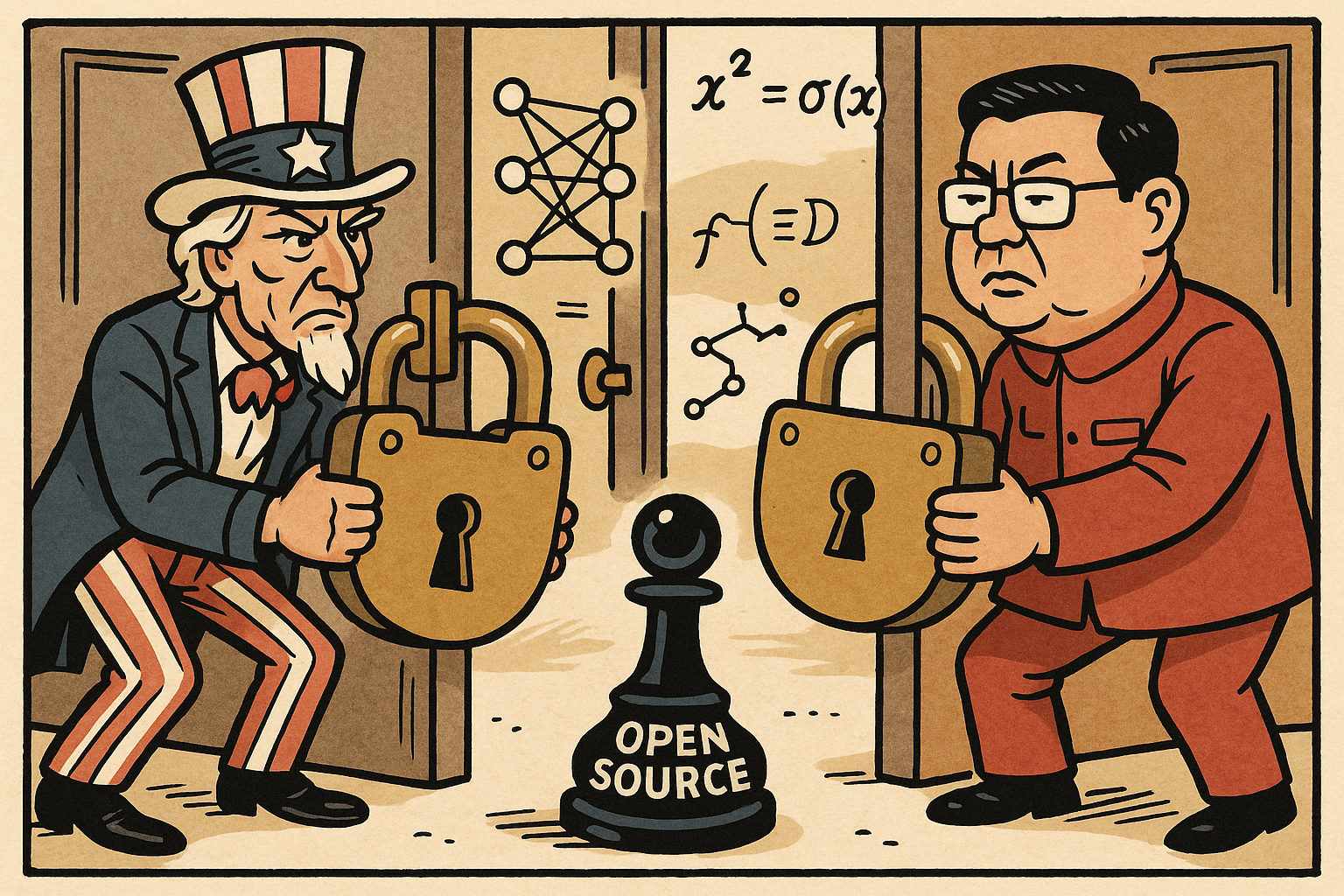
This week also brought the reversal of Meta's acquisition of Manus AI: China blocking a deal it had already approved, asserting that jurisdiction over Chinese-built AI follows the engineers who built it, not the holding company that acquired it. The instinct to treat this as exclusively a Chinese authoritarian move misses something. The US has done the same calculation from the other direction. The CFIUS review process exists precisely to block foreign acquisitions of American technology companies. The White House has attempted to restrict TikTok on national security grounds. The Manus reversal and the NVIDIA restrictions are mirror images. Both governments have concluded that AI capability is a strategic national asset that cannot be allowed to move freely across borders. Both are correct about the stakes. Both are wrong about the remedy.
You cannot embargo an idea. The mathematical foundations of deep learning are in published papers, textbooks, and open-source repositories. The architectural innovations that made DeepSeek competitive were published in research papers that anyone can read. The weights of open-source models, including DeepSeek's own, can be downloaded and fine-tuned anywhere with sufficient compute. What the export controls have succeeded in doing is signalling military intent, poisoning the well of international research collaboration, and ensuring that every major power now treats AI development as a matter of national survival rather than a shared civilisational project. The culture of AI research twenty years ago was one of the most internationally collaborative scientific communities in the world. That culture is being deliberately dismantled, and the people dismantling it are acting rationally within the logic of great-power competition. That logic is the problem.
In WarGames, the WOPR computer runs through every possible nuclear war scenario and eventually concludes: "A strange game. The only winning move is not to play." The line has become a cliché, but the underlying insight is exact. Nuclear deterrence worked because both sides understood that winning meant losing. The AI competition has not yet produced that recognition, because the stakes feel lower: no one dies immediately when a frontier AI model trains in Beijing rather than San Francisco. But the trajectory matters. The competitive dynamic being established now, in which AI capability is a military asset to be hoarded and restricted, is building toward a world in which the technology's development is governed entirely by geopolitical rivalry rather than by any consideration of what is actually good for the people it affects.
The workers whose jobs AI eliminates are not primarily concerned with whether the model doing it was trained in China or California. The economic displacement I have been writing about since before most people were taking this seriously does not care about export control jurisdiction. The labour-income loop that is breaking down as AI labour costs approach zero breaks the same way whether the AI was built on Huawei chips or NVIDIA chips. The arms race between Washington and Beijing over who controls frontier AI is a competition over who gets to manage the disruption, not a competition over whether the disruption happens. It is happening regardless. The workers bearing the cost are watching both governments compete over strategic control of the technology while neither government has anything coherent to say about the economic consequences for ordinary people.
I do not think the export controls will be lifted. I do not think the decoupling will reverse. The political incentives are too strong and the security bureaucracies too large. What I think is that we are watching the encryption wars happen again, in slow motion, with higher stakes, and that in twenty years we will have a complete Chinese AI ecosystem that is fully independent of the American one, a chilled international research culture, and no more capability to govern the technology globally than we have now. The only winning move, as WOPR worked out, is not to play. We are playing anyway.