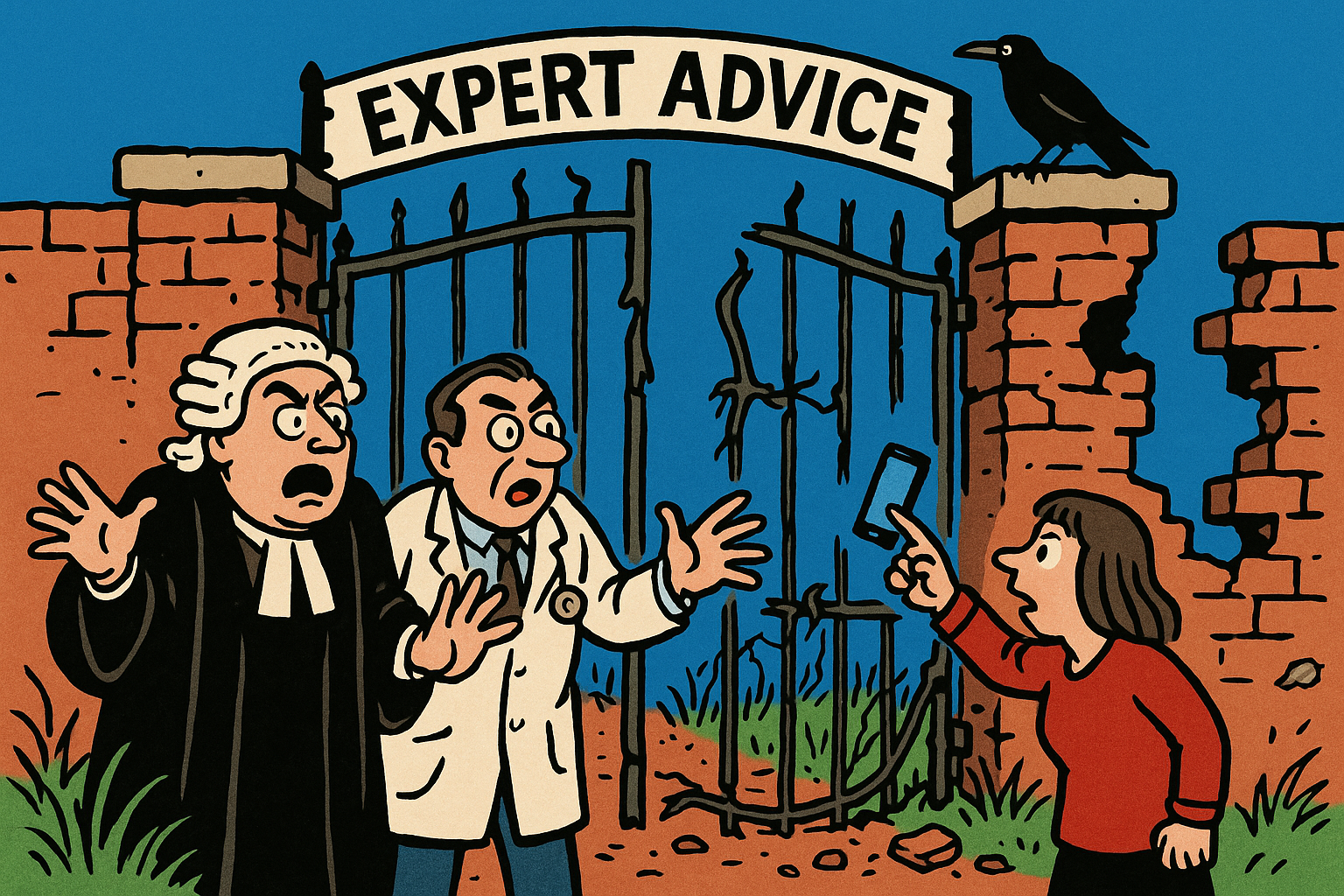
The argument runs like this: the AI tool is not good enough to replace a professional. The outputs are unreliable, the judgment is absent, the work falls short of what a trained human produces. This argument is made by doctors, lawyers, journalists, musicians, and software developers, and in each case it is accompanied by a second argument, made by the same people, sometimes in the same breath: that AI is threatening their livelihoods, eliminating jobs, and requires urgent legal protection to contain. These two positions cannot both be true. A technology too unreliable to do a job is not a threat to the people who do it. The fact that the threat argument is being made at all is a concession that the competence argument has already lost.
The Recording Industry Association of America and the Music Workers Alliance describe AI music as offering "shortcuts, knockoffs, and low-quality imitations." More than two hundred artists, including Billie Eilish and Nicki Minaj, signed an open letter describing AI as a threat to their privacy, identities, music, and livelihoods. The RIAA has filed landmark copyright suits against AI music platforms Suno and Udio in federal court. The record industry's revenue hit a new high of $11.5 billion in 2025. These facts coexist without apparent tension in the industry's public communications, because each serves a different purpose. The quality argument justifies regulatory intervention. The threat argument justifies compensation claims. Neither argument acknowledges that if AI music were genuinely inferior, the market would handle it without legislation. Markets are good at rejecting inadequate products. Legislation is needed when the product is adequate enough to compete.
Bar associations and courts have responded to AI's entry into legal work with mandatory disclosure requirements and financial penalties for AI-hallucinated content. The argument is that AI is too unreliable for legal filings. Simultaneously, 79% of legal professionals are now using AI tools, and the profession's own analysis acknowledges that AI is best suited to the tasks "often assigned to junior professionals: synthesizing documents, drafting summaries, producing routine filings." The same technology adjudged too unreliable for a tenant's tribunal claim is being deployed at scale internally by the same firms warning about its unreliability. The reliability concern attaches to the individual litigant using AI without a lawyer. It does not attach to the firm using AI to reduce how many lawyers it needs.
The American Medical Association frames AI as "augmented intelligence" — a supplement to doctors, not a replacement — and has lobbied for governance frameworks before any expansion of AI's clinical role. These are reasonable positions. They coexist with a documented reality: Google's MedGemma, a purpose-built medical AI model released in May 2026, scores 87.7% on MedQA and runs on mobile hardware. In New Zealand, 44% of Maori have unmet primary care needs and 32% cannot contact a GP due to cost. Maori live seven years less than non-Maori. The GP funding formula taking effect this July was revised to exclude ethnicity from its allocation criteria, despite expert advice to include it. Dr Gabrielle McDonald of Otago University put the consequence plainly: "Leaving ethnicity out means it's not going to be allocated to those highest areas of need." The system being protected is not serving the people it is supposed to serve. The technology being described as inadequate is already operating at clinical performance levels in specific domains, speaks every language, and is available at three in the morning.
In April 2026, around 150 ProPublica journalists staged what labour experts described as the first US newsroom strike driven primarily by demands for AI job protections. Ninety-two percent of the union voted to authorize it. Over 17,000 entertainment and media jobs were cut in 2025. Journalist unions are negotiating contract clauses restricting AI-generated content and protecting against displacement of human reporters. The Associated Press has been using AI to generate earnings reports since 2014. The piece you are reading was produced with AI assistance. The argument that AI cannot do journalism and the evidence that it is already doing journalism are being made simultaneously, in different rooms, by people who understand both to be true.
The argument that AI-generated code is unreliable has genuine empirical support: studies find higher rates of security vulnerabilities in AI-assisted codebases compared to purely human-written code. This is a real finding. It coexists with the collapse of junior developer hiring. India's top five IT firms went from 18,000 net hires to 17 in a single year. Cursor, an AI coding tool, reached two billion dollars in annualised revenue. Ninety-two percent of US developers now use AI coding tools daily. The profession arguing that AI code cannot be trusted has restructured its entire hiring pipeline around AI-augmented production. The reliability concern is real. It is not the reason junior hiring collapsed.
Copyright suits, licensing frameworks, mandatory disclosure requirements, bar association governance rules, union contract clauses: these are not primarily measures to protect the public from incompetent technology. They are instruments for slowing a transition, extracting compensation during it, and securing the political conditions under which incumbents can adapt. That is a legitimate use of democratic institutions. Professions have always used them when their market position was threatened. There is nothing uniquely dishonest about the current wave of professional resistance to AI.
What is dishonest is the framing. The competence argument is being deployed as consumer protection language for what is, at bottom, a labour protection interest. Consumer protection says: this technology is dangerous to the people who use it. Labour protection says: this technology is dangerous to the people whose jobs it replaces. Both can be true simultaneously. But running them together, in the same sentence, using the same regulatory machinery, obscures which argument is actually doing the work. It makes it harder to evaluate either claim on its own terms, and harder still for the public to understand what is actually being asked of them.
AI is credible enough in each of these domains to threaten the incumbents. That is precisely why the barriers are being built. A technology genuinely unfit for a purpose does not require legislation to keep it out. What requires legislation is a technology adequate enough to compete, and winning. The professionals most loudly insisting that AI cannot do their jobs are the same professionals watching it do their jobs. Both observations are accurate. Only one is being stated in public.