I am a software developer. I have been writing about AI and work since before ChatGPT made the subject fashionable. And this week I found myself reading about India's IT sector graduates the way you sometimes read about something that has already happened to you: with a sick recognition, and not much surprise.
The numbers are stark. India's top five IT companies, the foundations of a three-hundred-billion-dollar outsourcing industry, recorded net hiring of seventeen people in the first nine months of this financial year. A year earlier: nearly eighteen thousand. Wipro has declared it has no fresher hiring target at all. Quess Corp estimates that graduate intake at the top ten IT firms has roughly halved in two years. A 22-year-old in Belagavi who chose computer science in 2022 because she heard it had good scope for the future is now looking at a market that has restructured itself around her.
Everyone has an explanation. The pandemic over-hiring is correcting. Macro conditions are soft. And yes, AI is doing some work that junior developers used to do. The disagreement is always about what proportion is structural versus cyclical. I think that argument is a way of avoiding the part that is uncomfortable to state directly.
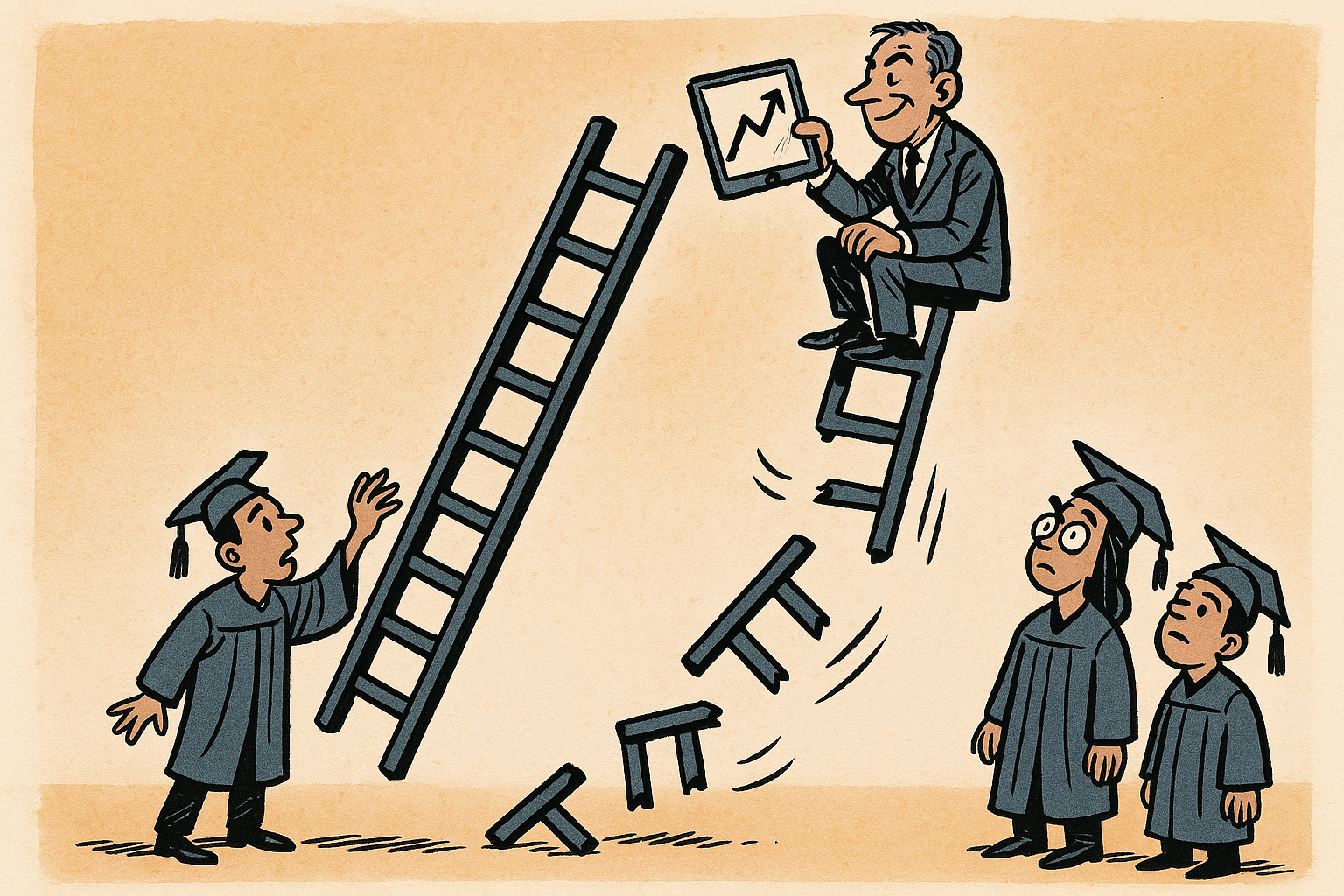
Junior roles in software are not just jobs. They are how the profession reproduces itself. They are where engineers learn to read code they did not write, to navigate systems large enough that no individual built them from scratch, to develop instincts about when something is about to fail. A senior engineer is not someone who knew things at 22 that a junior doesn't. A senior engineer is a junior engineer who was given time and problems. When the profession stops bringing in large numbers of juniors, it is quietly dismantling the training pathway that produces its own future. That cost does not show up anywhere in this year's productivity calculations. It shows up in three to five years, when you need someone with judgment and the pipeline is empty.
The standard response is: upskill. Learn to work with AI. Become one of the people who orchestrates AI agents rather than one of the people the agents replaced. Some people will do this. Some of them will succeed. The question I keep asking is: how many? The firms cutting junior headcount are not hiring proportionally more AI-skilled engineers. They are hiring fewer people overall. The productivity gains mean they need fewer humans to produce the same output. Upskill into what, exactly? Into a smaller pool of roles, for which you are competing with everyone else who got the same advice?
The waterline is not "learn to use AI tools." I use AI tools every day; they have made me more productive; I am not sure they have made me more secure. The waterline is "outperform AI at cognitive work, or work in a domain AI cannot yet reach." For a large fraction of the people who chose software careers because they were good at maths and wanted a stable income: that bar does not exist at a reachable height. Telling them otherwise is cruelty dressed as encouragement.
Here is the argument I want to direct upward, not at the graduates. The companies announcing productivity gains while cutting junior hiring are externalising a cost. All those unhired graduates planned to pay rent, buy things, build the moderate consumer demand that sustains the economy those same companies operate in. When a company captures the efficiency of AI while reducing its payroll, it is offloading the demand-side consequence onto everyone else. The labour-income loop, the one where companies employ people, people earn money, people buy things, companies have customers, does not self-repair when you subtract people from it. It degrades.
Individual corporate decisions to cut junior hiring are rational. The collective result of all those rational decisions is a generation of people locked out of the entry point of a profession, carrying debt from degrees whose career paths have contracted under them. That is not a conspiracy. It is just what happens when the incentive structure rewards individual efficiency and externalises collective costs. It is also not, despite what some optimists will tell you, a temporary transitional pain on the way to better jobs on the other side. We do not know what is on the other side. We know what is being taken away now.
I don't have a policy prescription that works at the scale of this problem. Robotic rights are my long-horizon speculative answer to the structural version of it, but they are not a near-term solution for anyone finishing their degree this year. What I can say is that the productivity numbers being cited to celebrate AI adoption are not a full accounting. They are the revenue side of a ledger that has not yet shown the costs. Those costs are being paid right now, quietly, by people the people celebrating are not looking at.