I started out with dBase and Clipper. My toolset was a PC and, eventually, a local area network. The world I was developing for was narrow: a single business, a handful of users, one machine or a small cluster of them. The knowledge required to serve it was correspondingly narrow. You learned one language well, understood one deployment environment, and built things that worked. The ceiling was low, but it was reachable. A person of ordinary talent who was willing to put in the work could become genuinely good at what was being asked of them.
That environment was, I understand now, a gift. Not because the work was easy but because the scope was learnable. You could go deep, and depth was what the work rewarded.
This is how expertise actually forms. A piece in Bar and Bench this week makes the argument precisely in the context of junior lawyers: the rote drafting, the document review, the plaint returned more red than black, and somewhere in the second year, instincts forming that nobody explicitly transmitted. The repetition, applied to a constrained domain, built something that couldn't be built any other way. You can't shortcut it, and you can't distribute it across ten domains at once. Depth requires time and focus, which means it requires a degree of narrowness. Even the most capable people trade breadth against depth. A specialist goes deep and accepts the limits of their range. A generalist covers ground and accepts they won't be expert at any single thing. These are real tradeoffs, not failures of ambition.
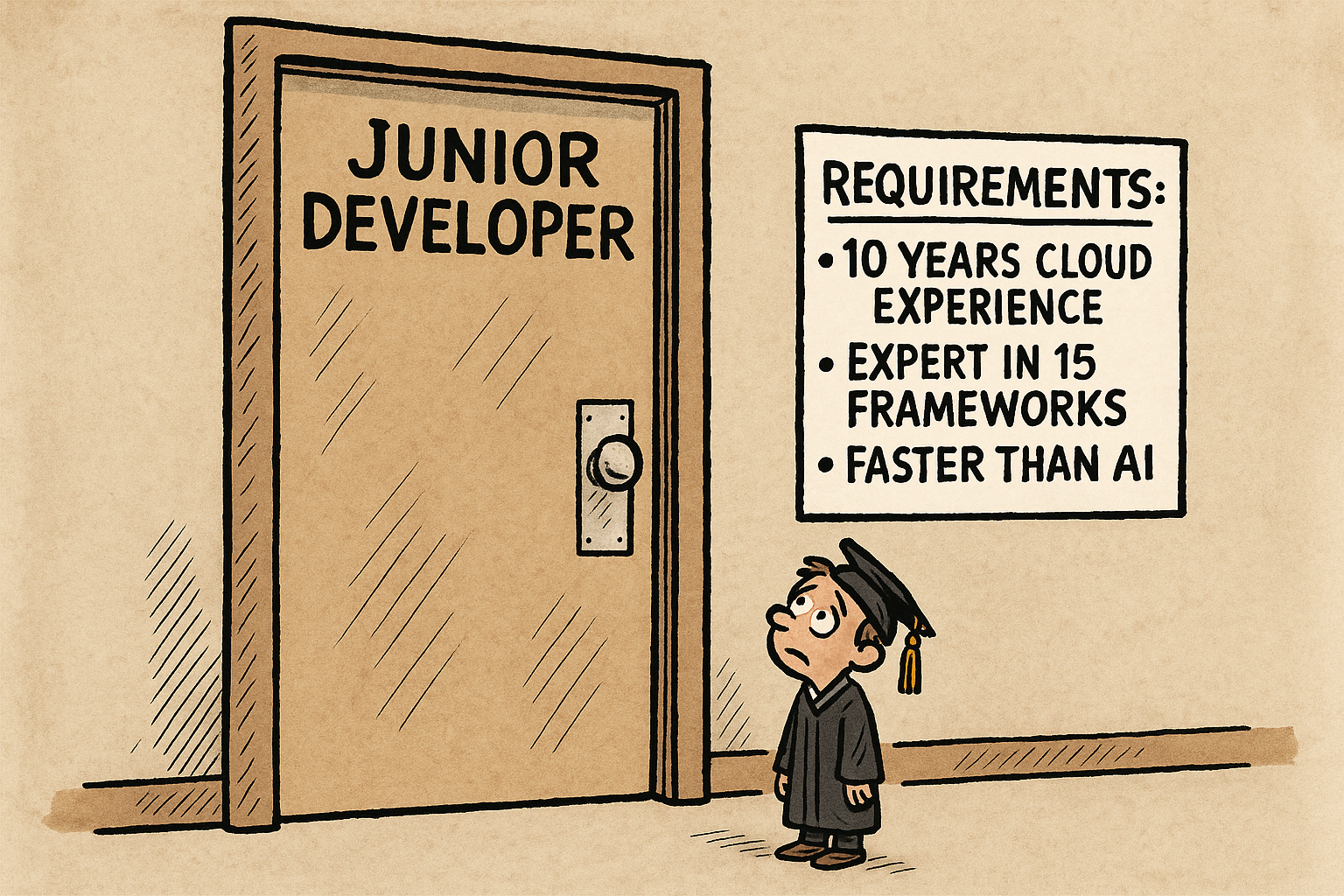
The entry bar for software development today ignores this entirely. A junior developer is now expected to be conversant across cloud infrastructure, multiple languages, containerisation, CI/CD pipelines, and half a dozen frameworks as a condition of starting. Not curious about these things, not learning them: proficient in them. And then, beyond proficiency, competitive. Competitive with developers who have been using AI tools for years, who are more productive per hour than any developer was five years ago. The expectation is breadth and depth simultaneously, from someone at the beginning of their career.
That is not an entry bar. It is a description of someone who doesn't exist.
Even a genuinely exceptional person doesn't arrive expert across broad domains. Expertise is earned in specific territory, through specific work, over time. The scientists who change their fields are typically deep in one area, not uniformly brilliant across ten. The developers who built the tools the industry now relies on spent years on narrow problems. The breadth that some of them later developed was built on top of that depth, not instead of it.
I use AI tools every day. I have to: the competitive pressure is real and the choice is largely notional. But I'm aware that the tools making me more productive are the same tools setting this impossible standard at the entry level. When every working developer is AI-augmented, the baseline expectation for what a developer can produce shifts upward, and the junior developer trying to get their first foothold is being measured against that shifted baseline before they've had the chance to develop any real depth in anything.
The industry talks about this as a skills problem, a training problem, a pipeline problem. It is not. It is an expectations problem. We have built an entry requirement that contradicts how human expertise actually develops, and then expressed surprise that fewer people are clearing it. We are not failing to produce enough supergeniuses. We are demanding supergeniuses where ordinary talented people, given time and a learnable scope, would have been perfectly good developers.
In 1990, someone could learn Clipper, build accounting software for small businesses, and have a career. That person exists in large numbers. The profession no longer has a place for them. That seems worth naming, even if the industry would prefer not to.