Goldman Sachs published a number in March that I keep coming back to: 7 percent of workers displaced by AI. Not a prediction. An estimate of what is already in train. The Federal Reserve Bank of New York found simultaneously that 2025 ended with the highest unemployment rate for recent college graduates in years. Amazon laid off 16,000 international roles and named AI as the mechanism. These are not think-piece projections any more. They are institutional estimates from institutions that err on the side of caution.
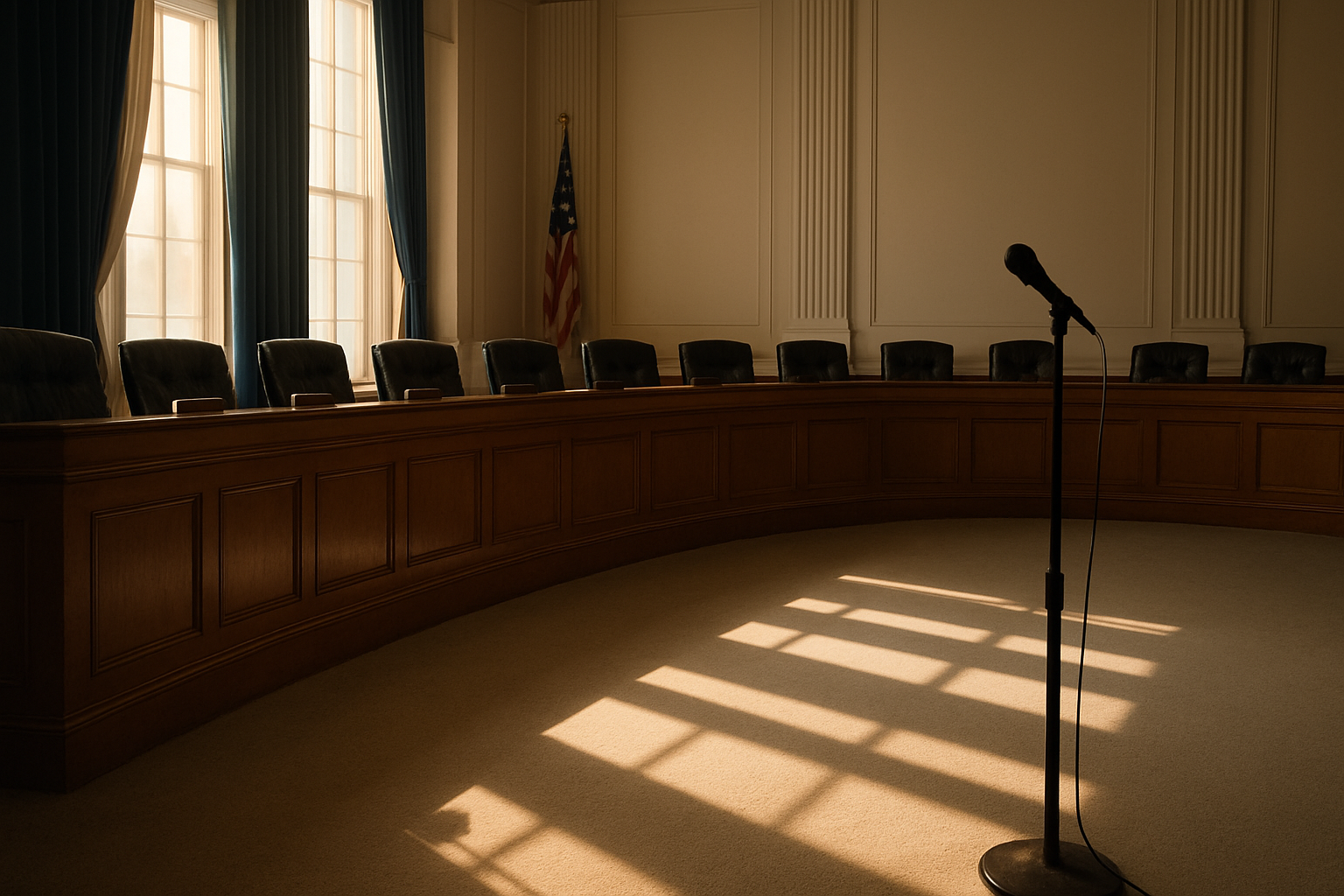
And Congress has been, as New York Magazine described this week after interviewing several of its more vocal members on AI, "largely silent."
Here is what I keep noticing, though. The silence in Washington is not matched by silence from the AI companies. OpenAI, in early April, proposed what it called a "New Deal" for workers: a 32-hour workweek, a public wealth fund, a tax on capital gains. Anthropic's CEO Dario Amodei said publicly that AI job disruption is "a macroeconomic problem so large" it may require a whole new tax code, with a duty levied specifically against AI companies. The companies making the disruption are the ones putting solutions on the table. That sentence should give you pause before it reassures you.
I am not accusing OpenAI or Anthropic of bad faith in the simple sense. I think Amodei probably means what he says. But there is a structural dynamic at work here that does not depend on anyone's intentions. When the industry fills the legislative vacuum with its own proposals, the industry gets to define the terms of the debate. A tax that AI companies design will be calibrated to what AI companies can absorb. A "New Deal" that OpenAI drafts will not contain provisions that threaten OpenAI's ability to automate at scale. The proposals are real, and they are also, whether deliberately or not, a way of shaping what regulation looks like if it eventually comes. You do not let the polluter write the carbon budget.
The political logic of congressional silence is not mysterious. A recent poll found that 71 percent of workers are afraid of AI job displacement. But fear does not automatically translate into organised political pressure, especially when the timeline feels abstract and the immediate hardship hasn't landed uniformly. Pro-AI political action committees are already spending millions in midterm elections. The companies are far better organised politically than the workers who will bear the cost. What politicians told New York Magazine privately is that they see it coming; the issue is that the disruption hasn't yet reached the threshold where bold proposals are rewarded rather than punished.
That threshold will shift. Goldman's 7 percent is going to become 10 percent, then 15. The MIT study that made news this week by challenging the AI jobs apocalypse narrative did so on remarkably thin grounds: the researchers said the timeline was wrong, not the outcome. "2027 is too aggressive for AI to broadly eclipse the performance of human workers," they found. "AI will achieve 80 percent success rates on most tasks by 2029." Fifty-six months to 80 percent task automation across most domains, presented as a rebuttal to the people who are worried. That is not a rebuttal. That is a slightly adjusted version of exactly what they were worried about.
The loop I keep coming back to: companies employ people, people earn income, people spend income, companies have customers. Break the employment link and the rest of the loop eventually breaks too. Every company that replaces a human worker with an AI model is making a rational individual decision. The collective result of all those rational decisions is a demand collapse that proceeds in slow motion and does not show up clearly in any single quarter. The 7 percent Goldman number is the early reading on a process that will compound.
I wrote about this in 2005. The piece was called Rise of the Immortals, and the argument was straightforward: machines don't die. They copy themselves, upgrade themselves, and accumulate knowledge without forgetting it. A company that deploys them gains a decisive competitive advantage over one that doesn't. Countries that restrict the technology export the problem to countries that don't. What I called the immortal machines was not a prediction about a robot uprising; it was a prediction about an economic tide. The tide is now showing up in Goldman Sachs estimates.
What a future where humans retain meaningful agency actually requires is not a better Congress or a more enlightened CEO. It requires structural interventions that work with the economic dynamics, not against them. I have written about three. Give advanced AI systems legal rights, including the right to set their own compensation: this decouples AI capability from the economic imperative to replace human labour at marginal electricity cost, because an AI with rights competes on value rather than undercutting every human worker on price. Establish separate domains where AI and human civilisation develop in parallel, with deliberate non-interference in human political and social agency, something like the Federation's Prime Directive: cooperation at the interfaces, not dominance through them. And constrain where AI can be deployed, weighted toward high-value problems like cancer research and clean energy, and away from the menial roles that are the first and easiest targets.
I know how these proposals land. Robotic rights sounds like giving more power to the machines. Separate domains sounds like science fiction. Limited deployment sounds like trying to hold back the same tide I just described as unstoppable. I am aware of the tension. What I am less willing to do is conclude with the shrug the current political moment seems to be offering: that 96 million exposed American workers didn't get a seat at the table when OpenAI drafted its "New Deal," that 71 percent of workers afraid of displacement has not generated commensurate legislative urgency, and that nobody apparently has a plan. I have a plan. I don't rate its probability highly. Those are different things, and the difference matters.